
Types of Cubic Equations: Complete Guide with Examples
Discover the different types of cubic equations! Learn to identify monic, depressed, factored, and perfect cube equations with 15 examples and 30 practice problems.
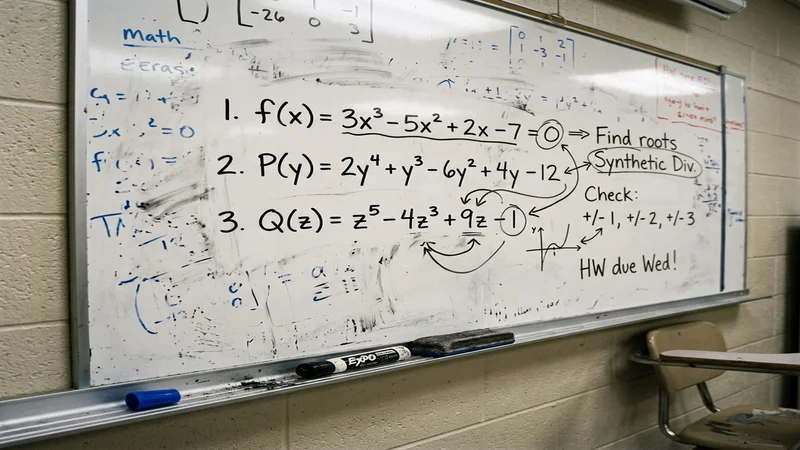
Introduction
In the study of algebra, encountering your first third-degree polynomial is a major milestone. But as you dive deeper into the mathematics, you quickly realize that not all cubic equations look or behave the same way. There are actually several distinct types of cubic equations.
What are cubic equations? At their core, they are algebraic equations where the highest power of the unknown variable is exactly 3. However, depending on which terms are present, what the coefficients are, and how the roots behave, these equations fall into different structural categories.
Why is understanding different types important? If you treat every cubic equation exactly the same, you will waste countless hours on overly complex mathematical formulas. Imagine trying to use the quadratic formula to solve when you could just take the square root. The same principle applies here.
How identifying the equation type helps: By identifying whether an equation is a depressed cubic, a monic cubic, or a factored cubic, you unlock a shortcut. Identifying the type immediately tells you which specific solving method—be it grouping, the Rational Root Theorem, or Cardano’s Method—will be the fastest and most accurate.
What readers will learn: In this comprehensive guide, we will break down the seven primary types of cubic equations. You will learn the definition, properties, and standard forms of each type. We will compare them, look at how they graph differently, explain which solving methods to pair them with, and walk through dozens of examples and practice problems.
What Is a Cubic Equation?
Before dividing them into specific types, let us briefly refresh our general understanding of the cubic equation.
A cubic equation is a polynomial equation of degree 3. This means that if you look at all the variables in the equation, the largest exponent attached to any of them is a 3.
The universal general form of a cubic equation is:
Here is the role of each coefficient:
- (Leading Coefficient): Attached to the term. It determines the “width” of the S-curve graph and its end behavior. Crucially, cannot equal 0. If it did, the equation would become a quadratic ().
- (Quadratic Coefficient): Attached to the term. It helps determine the location of the graph’s turning points.
- (Linear Coefficient): Attached to the term. It influences the slope of the curve as it crosses the y-axis.
- (Constant Term): The number without a variable. It represents the exact point where the graph crosses the vertical y-axis.
Why Are Cubic Equations Classified into Different Types?
Mathematicians classify cubic equations into subtypes for several incredibly practical reasons:
- Different Mathematical Properties: Some cubics have three distinct real roots, while others have one real and two complex roots. Some curve wildly with peaks and valleys, while others are relatively flat.
- Different Solving Methods: This is the most crucial reason. A depressed cubic can be solved using Cardano’s historic formula. A factored cubic requires almost zero math to solve. A monic cubic is ideal for synthetic division.
- Graph Behavior: The type of cubic tells you instantly what the graph will look like. For instance, a perfect cube equation always has an inflection point sitting directly on the x-axis.
- Applications: In computer science, factored cubics are used to build specific curves in vector graphics. In physics, irreducible cubics appear frequently when modeling fluid dynamics.
- Advantages of classification: By looking at a problem and immediately saying, “Ah, this is a depressed cubic,” you save yourself from going down mathematical dead ends.
Now, let’s explore the 7 specific types of cubic equations.
Type 1. General Cubic Equation
Definition
The general cubic equation is the “catch-all” category. It is the full, unsimplified, foundational equation containing all possible terms from the third degree down to the constant.
Standard form
(where )
Properties
- It possesses all four terms (, and the constant).
- The leading coefficient () is typically a number other than 1.
- Because it is completely “full,” it is generally the most difficult type to solve by hand. It often requires grouping, the Rational Root Theorem, or heavy polynomial long division to crack.
Examples
When it appears in mathematics
This is the raw data you usually receive in physics, engineering, or word problems before you have had a chance to simplify, divide, or factor the equation.
Type 2. Monic Cubic Equation
Definition
A monic cubic equation is a specific version of the general cubic where the leading coefficient () is exactly 1.
Condition where the leading coefficient equals 1
In the general formula , if we set , the equation simplifies. Because we do not write the number 1 in front of variables in algebra, the simply becomes .
Standard form:
Properties
- The term stands alone without a visible number attached to it.
- Advantages: Monic polynomials are vastly superior for applying the Rational Root Theorem. Because the leading coefficient is 1, the possible rational roots of the equation are simply the factors of the constant term (). You do not have to worry about fractional roots.
Worked examples
- How to create one: If you have , you can divide every single term by 3 to create the monic cubic: .
Type 3. Depressed Cubic Equation
Definition
A depressed cubic equation is a cubic equation that is missing its term entirely. It has been mathematically “depressed” by one term.
General form
(Notice that ).
Why the quadratic term is removed
While it might seem like a random missing term, the depressed cubic is one of the most historically significant equations in mathematics. In the 1500s, Italian mathematicians realized that solving the general cubic equation was nearly impossible. However, they discovered a mathematical substitution trick (setting ) that could perfectly eliminate the term from any general cubic equation, turning it into a depressed cubic.
Connection with Cardano’s Method
Once the equation is transformed into a depressed cubic (), mathematicians can use Cardano’s Method—a specific, brilliant algebraic formula—to find the exact roots. You cannot use Cardano’s Method on an equation that still has its term.
Worked examples
- (This is missing both the and terms, making it a highly simplified depressed cubic).
Type 4. Factored Cubic Equation
Definition
A factored cubic equation has been broken down into a multiplication problem consisting of its linear binomials.
Factored form
(Where and are the roots of the equation).
Finding roots directly
The greatest advantage of this type is that the solving work is already done for you. Because of the Zero Product Property, if a set of numbers multiplies to zero, at least one of those numbers must be zero. Therefore, you simply set each parenthesis to zero, and you instantly have your three roots.
Relationship with graphing
Factored cubics are a dream for graphing. Because the roots are instantly visible, you know exactly where the curve intersects the horizontal x-axis without doing any heavy calculation.
Examples
- (Roots are , and )
- (Roots are , and )
Type 5. Perfect Cube Equations
Definition
A perfect cube equation is a cubic polynomial that can be factored into a single binomial raised to the power of three.
Perfect cube identities
You can recognize these by expanding the perfect cube formula:
Recognizing perfect cubes
They are difficult to spot in the wild. You must check if the first and last terms are perfect cubes (e.g., and ), and then check if the middle terms perfectly match the and pattern.
When solved, a perfect cube equation always yields a root with a multiplicity of 3 (a triple root). The graph crosses the x-axis, but flattens out perfectly horizontally for a split second as it crosses, meaning the root is also the inflection point.
Worked examples
- Equation:
Notice: First term is . Last term is (which is ).
Factored form: . The root is . - Equation:
Factored form: . The root is .
Type 6. Cubic Equations with Repeated Roots
Definition
While every cubic equation has three roots, they do not have to be three different numbers. When a factor appears more than once, the equation has repeated roots.
Double roots vs Triple roots
- Double Roots (Multiplicity of 2): Two of the roots are exactly the same number. Formula: .
- Triple Roots (Multiplicity of 3): All three roots are the exact same number. Formula: (This is identical to the Perfect Cube equation).
Graph interpretation
Repeated roots create highly specific visual phenomena on a Cartesian plane.
- If a root is a double root, the graph will touch the x-axis at that number, turn around, and bounce back the way it came. The root is perfectly aligned with one of the turning points (a local maximum or minimum).
- If a root is a triple root, the graph passes straight through the x-axis but flattens out to a zero slope at the exact moment it crosses.
Worked examples
- (Roots are , and . The graph bounces at and crosses at ).
- (Roots are , and . The graph bounces at and crosses at ).
Type 7. Irreducible Cubic Equations
Definition
An irreducible cubic equation is one that cannot be factored using rational numbers (whole numbers and fractions).
Why they cannot be factored over the rational numbers
If you apply the Rational Root Theorem to an irreducible cubic, none of the potential fraction or integer roots will work. The roots of these equations are either highly complex irrational decimals (like ) or complex numbers involving .
Connection with numerical methods
Because you cannot neatly factor an irreducible polynomial into , high school algebra methods generally fail. To solve them, mathematicians rely on Cardano’s Method, or more practically, computational numerical methods like the Newton-Raphson method, which uses calculus to make progressively closer guesses to find the irrational decimal roots.
Examples
- (None of the possible rational roots, or , work. The roots are all irrational decimals).
Comparing All Types of Cubic Equations
To help you rapidly classify an equation when looking at it, here is a comparative overview:
| Equation Type | Standard Form | Leading Coefficient | Key Identifying Feature | Ease of Solving |
|---|---|---|---|---|
| General Cubic | , | Has all four terms, leading coefficient is not 1. | Difficult (Usually requires grouping or theorems). | |
| Monic Cubic | stands completely alone. | Moderate (Rational Root Theorem is highly effective). | ||
| Depressed Cubic | Any non-zero | Missing the quadratic term entirely. | Moderate to Difficult (Requires Cardano’s Method). | |
| Factored Cubic | Any non-zero | Broken down into parentheses. | Extremely Easy (Roots are visually obvious). | |
| Perfect Cube | First and last terms are perfect cubes. | Easy (Once identified). | ||
| Repeated Root | Any non-zero | Features a squared binomial factor. | Easy (Roots are visible, one is a bounce). | |
| Irreducible | Varies | Any non-zero | Cannot be factored with rational numbers. | Extremely Difficult (Requires calculators or Calculus). |
How to Identify the Type of a Cubic Equation
When confronted with a test question or an engineering problem, use this step-by-step decision process to classify the equation.
Step 1: Is it expanded or in parentheses?
- If it is in parentheses like , it is a Factored Cubic.
- If it is in parentheses like , it is a Perfect Cube / Repeated Root.
- If it is expanded out (), go to Step 2.
Step 2: Is the term missing?
- If yes (e.g., ), it is a Depressed Cubic.
- If no, go to Step 3.
Step 3: Is the number in front of exactly 1?
- If yes (e.g., ), it is a Monic Cubic.
- If no (e.g., ), it is a General Cubic.
Step 4: Can you factor it?
- If none of the basic factoring tricks work and there are no rational roots, it is an Irreducible Cubic.
Identification Examples
- : Expanded, is present, . General Cubic.
- : Expanded, is missing, . This is a Depressed Monic Cubic. (Equations can belong to more than one category!)
- : In parentheses, one factor is squared. Repeated Root Cubic.
- : Expanded, . It is a Monic Cubic.
Which Solving Method Works Best for Each Type?
Pairing the right method to the right equation type is the secret to mastering algebra.
| Solving Method | Best Used For | Why? |
|---|---|---|
| Factoring (Grouping) | General or Monic Cubics with 4 terms. | If the ratio of the first two terms matches the last two, it solves in seconds. |
| Rational Root Theorem | Monic Cubics. | When , you only have to check the integer factors of , making it very fast. |
| Synthetic Division | Any expanded cubic (once one root is found). | It is the fastest way to shrink a cubic down into a quadratic. |
| Cardano’s Method | Depressed Cubics. | The formula is specifically engineered to solve . |
| Numerical Methods (Calculators) | Irreducible Cubics. | Since algebra fails to find rational roots, computational estimation is required. |
| Zero Product Property | Factored Cubics, Perfect Cubes. | You simply set the factors to zero and write down the answer. |
Graph Behavior of Different Cubic Equation Types
The structure of the equation mathematically guarantees what the S-curve graph will look like.
General & Monic Cubic Graphs
These are the standard “S-curves.” They will almost always have two distinct turning points (a peak and a valley) and cross the x-axis one to three times.
Factored Cubic Graphs
Because the equation is , you instantly know the graph will weave perfectly through the x-axis at , and .
Repeated Root Graphs
- Double Root: The graph will approach the x-axis, touch the root, and violently curve back away from it, creating a turning point exactly on the axis line.
- Triple Root / Perfect Cube: The graph crosses the x-axis, but it does so cautiously. It flattens out perfectly horizontally at the root, making the root the exact inflection point of the entire curve.
Positive vs Negative Leading Coefficients
Regardless of the type, the leading coefficient () dictates the end behavior:
- Positive (): Graph goes down to the left, up to the right.
- Negative (): Graph goes up to the left, down to the right.
Real World Applications
Different fields rely on different types of cubic equations:
- Computer Graphics (Factored & Monic): When rendering 3D video games, software uses “Cubic Splines.” Programmers often use monic or factored cubics because they are computationally cheaper (faster) for a computer processor to calculate millions of times per second.
- Physics and Fluid Dynamics (Irreducible): Natural phenomena rarely result in clean, whole numbers. When modeling the Van der Waals equation of state for non-ideal gases, the resulting cubics are almost always irreducible, requiring numerical computer algorithms to solve.
- Architecture (Depressed Cubics): When calculating the stress and deflection of structural beams under a load, the equations often naturally simplify into depressed cubics.
- Economics (General Cubics): Cost and profit functions in business modeling use general cubics to represent the S-curve of production efficiency.
Common Mistakes
- Confusing Monic with Depressed Cubic: A monic cubic () has a leading coefficient of 1. A depressed cubic () is missing its term entirely. They are not the same, though an equation can be both (e.g., ).
- Incorrect classification of Factored Forms: Looking at and calling it a factored cubic. While it is partially factored, it is not fully factored into linear binomials.
- Ignoring repeated roots: If a student solves and only lists roots as , they fail to acknowledge that 3 is a double root, which is critical for graphing.
- Trying to use Cardano’s Method on a General Cubic: Cardano’s Method only works on a depressed cubic. You must mathematically remove the term via substitution before using his formula.
Worked Examples
Let’s look at 15 fully solved examples, identifying the type and solving them appropriately.
Example 1: Identifying a Monic Cubic
Equation:
Type: Monic Cubic (a=1).
Solution: Use grouping. .
Roots: .
Example 2: Identifying a Depressed Cubic
Equation:
Type: Depressed Cubic ( is missing).
Solution: Factor out GCF. .
Roots: .
Example 3: Factored Cubic
Equation:
Type: Factored Cubic.
Solution: Set factors to zero.
Roots: .
Example 4: Perfect Cube
Equation:
Type: Perfect Cube.
Solution: Notice and . It factors to .
Root: (Multiplicity of 3).
Example 5: Repeated Root
Equation:
Type: Repeated Root (once factored).
Solution: .
Roots: (Double root at 3).
Example 6: General Cubic
Equation:
Type: General Cubic.
Solution: Use Rational Root Theorem. Test .
. Root found.
Synthetic division yields . Factoring yields .
Roots: .
Example 7: Irreducible Cubic
Equation:
Type: Depressed, Monic, and Irreducible.
Solution: Rational roots () do not work. Requires numerical methods (Root is approximately ).
Example 8: Transforming to Monic
Equation:
Type: General Cubic.
Solution: Divide by 4 to make it Monic: .
Example 9: Factored with Complex Roots
Equation:
Type: Partially Factored Cubic.
Solution: . .
Roots: .
Example 10: Missing Constant Term
Equation:
Type: Monic Cubic (Constant ).
Solution: Factor . .
Roots: .
Example 11: Depressed and Monic
Equation:
Type: Depressed Monic Cubic (Difference of cubes).
Solution: .
Roots: .
Example 12: Converting to Standard Form first
Equation:
Type: General cubic (once expanded).
Solution: .
Type changed to Repeated Root. Roots: (double).
Example 13: General Cubic via Grouping
Equation:
Type: General Cubic.
Solution: .
Roots: .
Example 14: Perfect Cube with Negative
Equation:
Type: Perfect Cube.
Solution: Divide by -1: .
Root: (Triple).
Example 15: Purely Graphical Identification
Problem: A graph crosses at -2, touches the x-axis at 5 and bounces downward, and the left arrow points up.
Type: Repeated Root Factored Cubic with negative leading coefficient.
Solution: .
Practice Problems
Test your ability to classify and solve cubic equations. Solutions are provided at the end of the section.
Beginner Level (Classify the Type)
Intermediate Level (Classify and Solve)
- Classify & Solve:
- Classify & Solve:
- Classify & Solve:
- Classify & Solve:
- Classify & Solve:
- Classify & Solve:
- Classify & Solve:
- Classify & Solve:
- Classify & Solve:
- Classify & Solve:
Advanced Level (Classify, Manipulate, and Solve)
- Prove is a depressed cubic, then solve it.
- Convert into a monic cubic, then classify the roots.
- Write a factored cubic equation that has a double root at 3 and a single root at -4.
- Solve the perfect cube: .
- Is irreducible over rational numbers? Prove it.
- Write a general cubic equation whose roots are .
- Solve the depressed cubic .
- Find the roots of the monic cubic .
- A cubic touches the x-axis at and crosses at . Write its equation.
- Classify after simplifying it.
Solutions to Practice Problems
Beginner Solutions:- Monic Cubic
- Depressed Cubic (and General)
- Factored Cubic
- Perfect Cube (Monic)
- General Cubic (Missing constant)
- Repeated Root Cubic
- Depressed Monic Cubic
- General Cubic (Leading coefficient -1)
- Perfect Cube / Repeated Root (Triple root at 0)
- Perfect Cube
Intermediate Solutions: 11. Monic Cubic. Grouping: . Roots: . 12. Depressed Cubic. Factor . Roots: . 13. Perfect Cube. Root: (Triple). 14. Repeated Root. Factor . Roots: (Double). 15. Depressed Monic. Difference of cubes. Roots: . 16. General Cubic. Grouping: . Roots: . 17. Depressed Monic. Roots are factors of -6. Test (works). Divide to get . Roots: . 18. Depressed Cubic. . Roots: . 19. Repeated Root. . Roots: (Double), . 20. Factored Cubic. Roots: .
Advanced Solutions: 21. Missing term, so it is depressed. Test (works). Divide to get . Roots: . 22. Divide by 4: . (Roots are one real, two complex). 23. 24. Perfect cube of . Root is . 25. Yes. Possible rational roots are . Test all four: none equal zero. Therefore, irreducible over rationals. 26. . 27. Test . Both work. Roots are . 28. Grouping: . Roots: . 29. Touches = double root. or . 30. Expand: . It is NOT cubic; it is a quadratic equation!
Frequently Asked Questions
What are the different types of cubic equations?
The main types are general, monic, depressed, factored, perfect cube, repeated root, and irreducible cubic equations.
What is a monic cubic equation?
It is a cubic equation where the leading coefficient (the number multiplying the term) is exactly 1, formatted as .
What is a depressed cubic equation?
A cubic equation that is entirely missing its quadratic term, formatted as .
What is a factored cubic equation?
An equation that has been broken down into a product of linear binomials, such as , making it incredibly easy to find the roots.
What is an irreducible cubic?
An equation that cannot be factored using basic rational numbers (whole numbers and fractions). Its roots are either complex numbers or long irrational decimals.
How do I identify the type of a cubic equation?
Look at the standard form. Check if the term is missing (depressed), check if the leading coefficient is 1 (monic), or see if it is broken into parentheses (factored).
Can one equation belong to more than one type?
Absolutely. For example, is a Monic Cubic (because ) and a Depressed Cubic (because ).
Why is classification important?
Identifying the type tells you exactly which mathematical shortcut to use to solve it, saving you from doing complex formulas when simple factoring would work.
Which type is easiest to solve?
The Factored Cubic is the easiest because the roots are visually obvious. The Perfect Cube is also very easy once you recognize the pattern.
Which type is used in Cardano's Method?
Cardano’s historic method specifically requires the equation to be a Depressed Cubic. General cubics must be mathematically transformed into depressed cubics before using the formula.
What is a repeated root?
When a cubic equation factors into identical binomials (e.g., ), the root is repeated. It causes the graph to “bounce” off the x-axis instead of crossing through it.
How does a perfect cube graph look?
It creates an S-curve that flattens out perfectly horizontally right as it crosses the x-axis. This point is both the root and the inflection point.
Are all general cubic equations hard to solve?
Not always. If the coefficients allow for factoring by grouping (e.g., ), they can be solved in a few steps.
What does the Rational Root Theorem work best on?
It works best on Monic Cubics. Because the leading coefficient is 1, you don’t have to divide by any fractions when testing possible roots.
Is x^3 = 27 considered a type of cubic?
Yes, it is a perfect cube. In standard form, it is , which makes it a Depressed Monic Cubic.
Why do engineers care about cubic types?
Engineers use specific types for specific reasons. Factored cubics are used to program smooth “cubic spline” curves in software, while irreducible cubics appear when calculating complex fluid dynamics.
What happens if a cubic has no constant term?
If (e.g., ), you can immediately factor out an . This guarantees that one of the roots is exactly .
Can you turn a general cubic into a factored cubic?
Yes! That is the entire goal of solving algebraic equations. You use theorems and division to break the general form down into factored form to find the roots.
How many turning points does a perfect cube have?
Zero. Because it constantly moves in one vertical direction (only flattening momentarily at the axis), it has no peaks or valleys.
What is a double root on a graph?
A double root means the curve touches the x-axis and turns around without crossing it, forming a U-shape exactly touching the axis line.
Summary
Understanding the types of cubic equations is the ultimate “cheat code” for advanced algebra. By classifying an equation before you attempt to solve it, you instantly know how it behaves and which mathematical tool to grab from your toolbox.
To review:
- General Cubics () are the standard baseline.
- Monic Cubics () have a leading coefficient of 1, making the Rational Root Theorem a breeze.
- Depressed Cubics () are missing the quadratic term and hold the key to Cardano’s Method.
- Factored Cubics are already broken down, instantly revealing their roots.
- Perfect Cubes and Repeated Roots dictate specific graphical behaviors, like bouncing off the x-axis or flattening through it.
- Irreducible Cubics force us to use calculators or calculus to find complex decimal answers.
Before you dive into complex division or formulas, take five seconds to identify the equation type. It will make your mathematical journey significantly easier.
Continue your mathematical journey with our related guides:
- What Is a Cubic Equation? Core Concepts
- Standard Form of a Cubic Equation
- How to Solve Cubic Equations Step-by-Step
- Understanding Cardano’s Method
- Factoring Cubic Equations: The Complete Guide
- Mastering the Rational Root Theorem
- How to Use Synthetic Division
- Real vs Complex Roots Explained
- Cubic vs Quadratic Equations
- How to Graph a Cubic Function