
Standard Form of a Cubic Equation: Complete Guide with Examples
Master the standard form of a cubic equation! Learn the ax³+bx²+cx+d=0 format, identify coefficients, convert equations, and solve step-by-step examples.
Introduction
If you want to solve, graph, or understand third-degree polynomials, you must first learn to speak their language. In mathematics, that language is called the standard form.
What is the standard form? In algebra, standard form acts as a universal blueprint. It is a strictly organized way of writing an equation so that anyone—a student, a professor, or a computer program—can instantly identify its key components. For cubic equations, standard form means arranging all algebraic terms in descending order of their exponents and setting the entire expression equal to zero.
Why does standard form matter? Without a standardized format, mathematics would be chaotic. Imagine trying to use a formula or plug numbers into a calculator if every problem was written backwards, scrambled, or split across two sides of an equals sign. The standard form provides a necessary starting point for factoring, graphing, and applying advanced algorithms.
Where is it used? You will use standard form constantly in algebra, pre-calculus, and calculus. It is required for finding roots, identifying y-intercepts, using synthetic division, and entering data into graphing calculators. Furthermore, engineers and programmers rely on standard form when writing code to model physical realities like 3D movement and fluid dynamics.
What readers will learn: By the time you finish this comprehensive guide, you will be able to instantly recognize the standard form of a cubic equation, break down every single coefficient, and seamlessly convert any scrambled or complex expression into a neat, perfect standard form. You will also test your skills with extensive examples and practice problems.
What Is the Standard Form of a Cubic Equation?
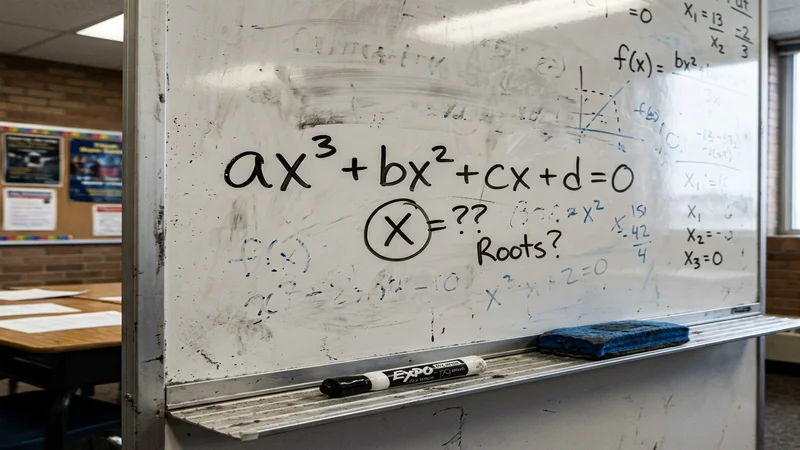
Let us get straight to the definitive mathematical blueprint. The standard form of a cubic equation is always written as:
Why is this the accepted mathematical representation?
Mathematics relies on order and predictability. This specific representation is accepted globally for three crucial reasons:
- Descending Order of Powers: The exponents count down logically: 3, then 2, then an implied 1 (on the term), and finally an implied 0 (since for the constant term ). This descending order ensures the most powerful term—the one that dictates the overall shape of the graph—comes first.
- Equating to Zero: Setting the equation to zero () is the fundamental step for finding the “roots” or “zeros” of the equation. Finding roots means finding the exact spots where the graph crosses the x-axis (where the y-value is exactly 0).
- Universality for Formulas: Every major formula for solving cubics (including Cardano’s method and the Rational Root Theorem) relies on identifying the coefficients , and . If the equation isn’t organized this way, the formulas completely fail.
Why ‘a’ Cannot Equal Zero ()
This is the golden rule of cubic equations. In the format , the letters , and represent real numbers.
However, can never be 0.
Why? Because if , then becomes 0. The term completely vanishes from the equation. You would be left with . Because the highest exponent is now a 2, this is no longer a cubic equation—it has collapsed into a quadratic equation. The presence of a non-zero term is the very thing that defines the equation as cubic.
Note: The other coefficients ( and ) are perfectly allowed to be zero!
Understanding Every Part of the Equation
To master the standard form, you need to understand the anatomy of the equation. Let’s dissect piece by piece.
Leading Coefficient ()
The number is the multiplier attached to the term. It is called the leading coefficient because, in standard form, it sits at the very front of the line.
- It determines the width of the graph.
- It dictates the end behavior (which way the arrows point on the far left and right sides of the graph). If is positive, the graph starts low and ends high. If is negative, it starts high and ends low.
- Example: In , the leading coefficient .
Quadratic Coefficient ()
The number is attached to the term. Alongside the other terms, it influences where the graph’s turning points (peaks and valleys) occur and where the inflection point sits.
- Example: In , the quadratic coefficient .
Linear Coefficient ()
The number is attached to the term. It primarily affects the slope of the cubic graph right at the point where it crosses the y-axis.
- Example: In , the linear coefficient . (When there is no number written before a variable, a 1 is implied).
Constant Term ()
The number stands alone with no variable attached. It is completely independent of .
- The constant term is incredibly important for graphing because it represents the y-intercept. If you plug in , the entire equation equals . Therefore, the graph crosses the vertical y-axis exactly at the point .
- Example: In , the constant term .
Variable ()
The letter represents the unknown value we are trying to solve for. It is the input of the polynomial function. While is standard, you can technically use any letter () as long as the structure remains consistent.
Degree
The degree of a polynomial is simply the highest exponent in the entire expression. Because the standard form requires an term, the degree of every cubic equation is exactly 3.
Quick Identification Examples
Let’s find and in various scenarios.
- Equation:
- , , ,
- Equation:
- , , , (Missing terms have a coefficient of 0).
- Equation:
- , , ,
Why Standard Form Is Important
Why do math teachers insist on you converting everything to standard form? It isn’t just to make the paper look neat; it is the required prerequisite for almost every mathematical operation involving polynomials.
Factoring
When attempting to solve a cubic equation through grouping or using the sum/difference of cubes, you must first organize the terms. If you try to group terms that are out of order, the greatest common factors will not align, and the factoring process will fail. Standard form groups the higher powers together and lower powers together, making patterns visible.
Graphing
To sketch an accurate graph, you need the y-intercept and the end behavior. Standard form hands you both on a silver platter. The first number () tells you the end behavior, and the last number () tells you the y-intercept.
Finding Roots
Whether you are finding one real root or three, standard form is essential. To find the roots, the equation must equal zero. If your equation looks like , you cannot find the roots because the right side is not zero. Moving everything to the left side into standard form is step one.
Using Cardano’s Method
Cardano’s historic algebraic method for solving cubic equations requires you to extract the values of and to calculate intermediate values ( and ). If your equation is not in standard form, you will pull the wrong numbers and the complex formula will break.
Using Online Calculators and Programming
If you use a website like WolframAlpha, a graphing calculator (like a TI-84), or write a Python script using NumPy (numpy.roots([a, b, c, d])), the computer expects the coefficients in descending order. If you enter , the computer assumes you mean . Standard form is the universal API for mathematical software.
Polynomial Analysis
Standard form allows you to easily apply mathematical theorems, such as Descartes’ Rule of Signs, which helps determine the possible number of positive and negative real roots based simply on how many times the signs (plus or minus) change from one term to the next in standard form.
Examples of Standard Form
Let’s look at 20 different equations and analyze whether they are in standard form or not, categorizing them by difficulty.
Easy Level
- Is it standard? Yes. Descending order, equals zero.
- Is it standard? Yes. Monic cubic ().
- Is it standard? Yes. It is a binomial, but is first, constant is last, equals zero. ( and are 0).
- Is it standard? Yes. A depressed cubic. Descending order.
- Is it standard? No. The term should be first.
- Is it standard? No. It does not equal zero. (Standard form: ).
Intermediate Level
- Is it standard? Yes. Fractions and decimals are perfectly acceptable coefficients.
- Is it standard? Yes. The constant term is 0.
- Is it standard? No. It must equal zero. You need to subtract 5.
- Is it standard? No. Terms are on both sides of the equals sign.
- Is it standard? No. It is in ascending order, not descending.
- Is it standard? No. This is not even a cubic equation, because .
- Is it standard? Yes. Perfectly valid. All coefficients are -1, and .
Advanced Level
- Is it standard? Yes. The coefficients are irrational numbers, but they are real numbers, in descending order, equaling zero.
- Is it standard? No. This is in factored form. It must be expanded.
- Is it standard? No. There are parentheses. You must distribute the .
- Is it standard? No. While close, standard form prefers individual coefficients: .
- Is it standard? No. There are two terms. You must combine like terms first ().
- Is it standard? No. Needs to be simplified to .
- Is it standard? Yes. Scientific notation or very small/large numbers are fine, as long as the form is .
Converting Equations into Standard Form
Most cubic equations you encounter in the wild or in word problems will not be perfectly formatted. You must force them into standard form.
The 4-Step Conversion Process
- Eliminate Parentheses (Expand): Use the distributive property or FOIL to multiply out any factored parts of the equation.
- Move All Terms to One Side: Use addition and subtraction to shift every term to the left side of the equation, leaving only a zero on the right side.
- Combine Like Terms: Add or subtract the coefficients of terms with the same exponent (e.g., combine and into ).
- Order by Descending Powers: Rearrange the remaining terms starting with , then , then , and ending with the constant number.
Worked Example A: Moving terms
Problem: Convert to standard form.
Step 1: No parentheses to expand.
Step 2: Move by subtracting it from both sides. Move by adding it to both sides.
Result:
Step 3: No like terms to combine.
Step 4: Rearrange in descending order.
Final Standard Form:
Worked Example B: Expanding and Combining
Problem: Convert
Step 1: Distribute the into the parentheses.
Step 2: Move terms from the right to the left. Subtract and add 5.
Step 3: Combine like terms. Look at the terms: .
Step 4: It is already in descending order!
Final Standard Form:
Common Mistakes When Working with Standard Form
Even advanced students make simple arithmetic errors when manipulating polynomials. Watch out for these five frequent mistakes:
- Wrong order of powers: Writing . The and are swapped. This will cause you to misidentify and , ruining any formula you try to use.
- Missing zero coefficients: When using synthetic division on , students often write the coefficients as . This is a catastrophic error. You must remember standard form includes all terms, even if they are zero: . The coefficients are .
- Negative sign errors: When moving a term like from the right side of the equals sign to the left, you must subtract it (). Students often forget to flip the sign, leading to incorrect polynomials.
- Leaving terms on both sides: Stopping at and trying to solve it. Standard form demands a zero on one side.
- Incorrect degree identification: Looking at , seeing the outside the parenthesis, and mistakenly assuming it is a cubic or quadratic without distributing. Expanding it yields , which is a quartic equation, not cubic!
Standard Form vs Other Forms
While standard form is universally important, mathematicians use other formats for specific tasks. Let’s compare them.
Comparison Table
| Form Name | Format | Best Used For |
|---|---|---|
| Standard Form | Identifying coefficients, using algorithms, standard graphing. | |
| Factored Form | Instantly identifying the roots () of the equation. | |
| Monic Cubic | Simplifying factoring methods (since ). | |
| Depressed Cubic | Applying Cardano’s Method. (Lacks the term). |
Factored Form vs Standard Form
Factored form looks like . It is amazing for finding roots—the roots are simply 1, -2, and 3. However, you cannot easily see the y-intercept or the exact graph shape without doing mental math. Standard form () makes the y-intercept (6) instantly obvious, but hides the roots.
Depressed Cubic vs Standard Form
A depressed cubic () is just a standard form equation where . In the 1500s, mathematicians realized that general cubic equations were too hard to solve. They discovered a substitution trick () that mathematically deletes the term, converting any standard cubic into a depressed cubic, which is significantly easier to solve.
Standard Form and Graphing
Graphing a cubic equation by hand begins by looking at the standard form, specifically the first term and the last term.
The Role of the Leading Coefficient ()
The sign of controls the end behavior of the S-curve.
- If (Positive): The curve starts in the bottom left, wiggles in the middle, and shoots up to the top right. As , .
- If (Negative): The curve starts in the top left, wiggles in the middle, and shoots down to the bottom right. As , .
The value of controls the width. A large number (e.g., ) creates a very steep, narrow, vertically stretched graph. A fraction (e.g., ) creates a wide, compressed, flattened graph.
The Role of the Constant Term ()
The constant term is the y-intercept. Because standard form is , if you want to find where the graph crosses the vertical y-axis, you set . The and terms all turn to zero, leaving only . You can plot this dot immediately without doing any math.
Turning Points
The middle coefficients, and , determine the shape of the “wiggle” in the middle of the graph. Depending on their values, the graph will have exactly two turning points (a peak and a valley) or zero turning points (a continuous slope that flattens momentarily).
Standard Form and Solving Cubic Equations
Every major technique for solving cubic equations relies on having the equation in standard form first.
- Factoring by Grouping: This method only works if the terms are ordered constant. You group the first two and the last two. If they are scrambled, grouping fails.
- Rational Root Theorem: This theorem states that any rational root of a polynomial is a fraction , where is a factor of the constant term () and is a factor of the leading coefficient (). If the equation isn’t in standard form, you won’t correctly identify the first and last numbers.
- Synthetic Division: To divide a polynomial rapidly, you list only the coefficients. becomes the array
[1, -4, 2, -1]. If the standard form is scrambled, or if you forget to include a 0 for a missing term, synthetic division will output entirely wrong numbers. - Calculators and Solvers: If you type a scrambled polynomial into a matrix solver or a programming array without organizing it into standard form first, the algorithm will misinterpret the powers of .
Real World Applications
Why do we care about ? Because the physical universe operates in three dimensions.
- Engineers use standard form cubics to calculate the volume of materials needed to construct three-dimensional shapes under varying constraints.
- Naval Architects use cubic equations to model the hull shapes of boats. The standard form allows them to tweak the and coefficients to adjust the curvature and water displacement of a ship’s bow.
- Economists use the standard cubic function to model cost. A factory’s production cost curve is often an S-shape (costs rise fast initially, flatten out as efficiency maximizes, then rise steeply again due to overcrowding). Standard form helps predict maximum profit points.
- Computer Programmers use cubic splines to create smooth animations. In video games, moving a camera from point A to point B smoothly requires the computer to calculate thousands of cubic standard form equations per second to ensure the movement doesn’t look rigid.
Worked Examples
Let’s walk through 15 fully solved examples of converting wild algebraic expressions into perfect standard form.
Example 1:
Problem:
Solution: Rearrange in descending order of exponents.
Standard Form:
Example 2:
Problem:
Solution: Subtract 10 from both sides so it equals zero.
Standard Form:
(Coefficients: )
Example 3:
Problem:
Solution: Move to the right side by subtracting.
Standard Form:
Example 4:
Problem:
Solution: Move everything from the right to the left.
Combine the terms.
Standard Form:
Example 5:
Problem:
Solution: Distribute the .
Subtract 5.
Standard Form:
Example 6:
Problem:
Solution: This is factored form. FOIL the first two binomials.
Now distribute every term in the trinomial to the binomial.
Combine like terms.
Standard Form:
Example 7:
Problem:
Solution: Move right side terms to the left.
Combine cubic terms.
Standard Form:
Example 8:
Problem:
Solution: Distribute the negative sign.
Move to the left side.
Standard Form:
Example 9:
Problem:
Solution: Distribute both chunks.
Combine terms and subtract 10.
Standard Form:
Example 10:
Problem:
Solution: Divide the left side by 2.
Move terms to the left.
Standard Form:
Example 11:
Problem:
Solution: Distribute .
Rearrange.
Standard Form:
Example 12:
Problem:
Solution: Distribute the 4.
Move to left side.
Notice the terms cancel out entirely ().
Standard Form:
Note: This is no longer a cubic equation! It has simplified into a quadratic.
Example 13:
Problem:
Solution: Multiply exponents.
Add 27.
Standard Form:
Example 14:
Problem: (where a is a constant number, not the leading coefficient)
Solution: It is already in standard form! The coefficient is .
Standard Form:
Example 15:
Problem:
Solution: Cube the entire term in parentheses.
Subtract .
Standard Form:
Practice Problems
Try to convert the following expressions into standard form (). Solutions are at the bottom of the section.
Beginner Level
Intermediate Level
Advanced Level
- (Treat ‘a’ as a constant)
- (Assume is positive)
- (Rearrange the abstract formula)
Solutions to Practice Problems
Beginner Solutions:Intermediate Solutions: 11. 12. 13. Cubics cancel: (Not a cubic!) 14. 15. 16. Expand: 17. 18. 19. 20.
Advanced Solutions: 21. Difference of cubes expansion: 22. 23. 24. Multiply by 4: 25. Group coefficients: 26. is . Form is 27. Distribute: 28. Expand: 29. 30.
Frequently Asked Questions
What is the standard form of a cubic equation?
The standard form is , where the terms are arranged in descending order of their exponents and the equation equals zero.
Why must 'a' not equal zero?
If the leading coefficient is zero, the term disappears. Without an term, the equation is no longer cubic; it becomes a quadratic equation.
Can coefficients be negative?
Yes, any of the coefficients (, or ) can be negative numbers.
Can coefficients be fractions?
Yes, coefficients can be fractions, rational numbers, or irrational numbers. The only restriction is that they must be real numbers, and cannot be zero.
Can coefficients be decimals?
Yes, decimals like are perfectly acceptable in standard form.
What if b equals zero?
If , the term is removed. The equation becomes . This specific type of standard form is called a “depressed cubic.”
What if c equals zero?
If , the linear term disappears. The equation looks like . It is still a valid cubic equation in standard form.
What if d equals zero?
If , there is no constant term. The equation looks like . This means the graph will cross the y-axis precisely at the origin .
How do you convert to standard form?
Expand any parentheses, move all terms to the left side of the equals sign using addition and subtraction, combine like terms, and arrange them from the highest exponent () to the lowest.
Why do calculators require standard form?
Algorithms used by calculators and computer software are programmed to expect a strict array of coefficients. If you don’t use standard form, the computer will assign the wrong coefficients to the wrong powers of .
What is a monic cubic equation?
It is a cubic equation in standard form where the leading coefficient () is exactly 1 (e.g., ).
Does standard form help with graphing?
Yes, immensely. The term tells you the end behavior of the graph, and the term gives you the exact y-intercept.
What is the degree of a standard cubic equation?
The degree is 3, which is the highest exponent in the polynomial.
Are factoring methods dependent on standard form?
Yes, methods like “factoring by grouping” require the terms to be logically ordered by descending powers to find common factors.
What is the Rational Root Theorem's connection to standard form?
The theorem divides the factors of the last term () by the factors of the first term (). You cannot identify the correct first and last terms unless the equation is in standard form.
Can standard form equal a number other than zero?
No. While you can write a cubic function as , a cubic equation meant to be solved must equal zero ().
Do I have to write out zero coefficients?
In general algebra, no (you can just write ). But if you are doing synthetic division or writing code, you must acknowledge them (as ).
What if my equation expands to have no x^3 term?
Then the equation was a “fake” cubic equation. If the terms cancel out, you are left with a quadratic (or linear) equation, and you solve it using those respective methods.
Why does descending order matter?
It standardizes mathematical communication worldwide. It puts the most mathematically significant term (the one that grows the fastest) at the front.
Can standard form have parentheses?
No. Standard form requires the expression to be fully expanded. If there are parentheses, it is likely in factored form, not standard form.
Summary
The standard form of a cubic equation, , is the universally accepted format for writing third-degree polynomials. By insisting that terms are arranged in descending order of exponents and set to equal zero, mathematicians created a standardized blueprint that makes advanced algebra possible.
Remember the golden rule: the leading coefficient can never be zero, or the equation stops being cubic. Meanwhile, the other coefficients dictate the shape, turning points, and y-intercept of the cubic curve.
Whether you are sketching a graph by hand, using the Rational Root Theorem, dividing polynomials with synthetic division, or writing computer code to model 3D physics, standard form is step one. By practicing how to expand, rearrange, and combine terms, converting messy algebraic expressions into clean standard form will become second nature.
Continue mastering cubic equations with our related guides:
- What Is a Cubic Equation? The Definitive Guide
- How to Solve Cubic Equations: Factoring & Beyond
- Mastering Cardano’s Method
- Real vs Complex Roots Explained
- Cubic vs Quadratic Equations: Key Differences
- How to Read the Graph of a Cubic Function
- Factoring Cubic Equations: Grouping and Difference of Cubes
- Step-by-Step Guide to Synthetic Division
- How to Use the Rational Root Theorem