
Mathematics
Real vs Complex Roots: Complete Guide with Examples
Master the differences between real and complex roots. Learn how to identify, calculate, and graph polynomial roots with our comprehensive step-by-step guide.
By Mathematics Educator | 6/30/2026
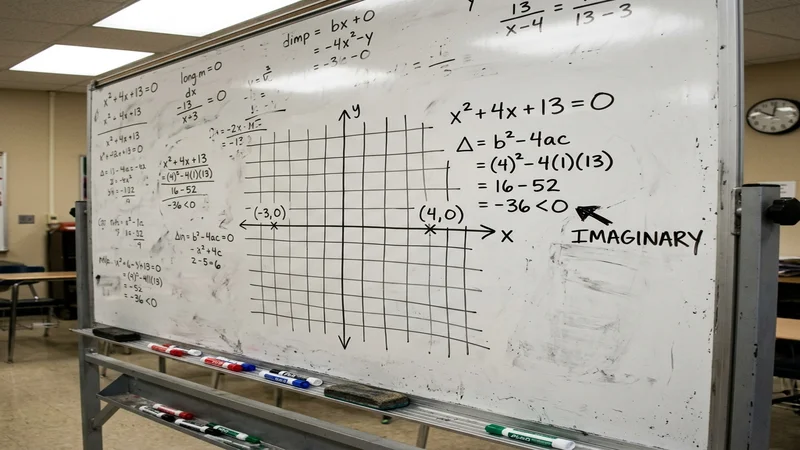
Understanding the nature of polynomial equations is a cornerstone of algebra. When you solve an equation, the answers you find, known as roots, can take different forms. They can be straightforward numbers you can point to on a number line, or they can be abstract mathematical concepts that require a deeper understanding of the complex plane.
This guide explores the fascinating distinction between real vs complex roots. Understanding root types is not just an academic exercise; it is essential for translating mathematical equations into physical reality. Real and complex roots dictate how structures behave under stress, how electrical signals oscillate, and how quantum mechanics model the universe.
In this comprehensive guide, you will learn exactly what real and complex roots are, how to identify them using the discriminant, and how they apply across engineering, physics, computer graphics, signal processing, economics, and numerical computing. Whether you are solving a basic quadratic or a high-degree polynomial, this article provides the tools and examples you need to master root classification.
Section 1. What Are Roots of an Equation?
Before diving into the complex plane, we must establish a solid foundation on what a root actually is.
Definition of a Root
In mathematics, a root (or a solution) of an equation is a specific value for the unknown variable that makes the equation true. If you have an equation defined by a function f(x), the roots are the values of x that satisfy the condition f(x) = 0.
Zeroes and Solutions
The terms “roots,” “zeroes,” and “solutions” are often used interchangeably in algebra. When we speak of the “zeroes of a polynomial,” we are referring to the specific inputs that result in an output of zero. Finding these zeroes is the primary goal of equation solving.
x-intercepts and Graphing
Graphically, roots have a profound visual meaning. If you plot a function y = f(x) on a Cartesian coordinate system, the real roots correspond perfectly to the x-intercepts: the exact points where the curve crosses the horizontal x-axis.
Relationship Between Equations and Graphs
The relationship between an algebraic equation and its geometric graph is absolute. If an equation has a root at x = 3, the graph of that equation will touch or cross the x-axis at the coordinate (3, 0).
Examples
- Linear Example: For the equation 2x - 4 = 0, the root is x = 2. The graph is a straight line crossing the x-axis at (2, 0).
- Quadratic Example: For x² - 9 = 0, the roots are x = 3 and x = -3. The graph is a parabola crossing the x-axis twice.
Section 2. What Are Real Roots?
Definition
Real roots are solutions to an equation that are entirely composed of real numbers. A real number is any continuous quantity that can be represented on a standard, one-dimensional number line. This includes integers, fractions, rational numbers, and irrational numbers (like √2 or π).
Properties
Real roots are tangible. They represent actual, measurable quantities in the physical world, such as time, distance, mass, or temperature. When an equation yields a real root, it is providing a quantifiable answer to a physical problem.
How to Recognize Them
You can recognize real roots because they do not contain the imaginary unit i. If a root can be calculated and written as a standard decimal, fraction, or radical (without a negative under an even root), it is a real root.
Graph Interpretation
On a standard xy-graph, real roots are highly visible. Every single real root manifests as an intersection point with the x-axis. If a polynomial graph crosses the x-axis five times, you can confidently state it has five distinct real roots.
Examples from Polynomials
- Quadratic: x² - 4x + 3 = 0 factors to (x - 1)(x - 3) = 0, yielding real roots x = 1 and x = 3.
- Cubic: x³ - 8 = 0 has one real root at x = 2.
- Higher Degree: x⁴ - 16 = 0 has real roots at x = 2 and x = -2.
Real-Life Meaning
In physics, if you are calculating the time it takes for a ball thrown in the air to hit the ground, the mathematical model might be a quadratic equation. The real root of that equation represents the exact second the ball impacts the earth.
Section 3. What Are Complex Roots?
Definition
Complex roots are solutions to an equation that include imaginary numbers. They occur when the mathematical process requires taking the even root (like a square root) of a negative number, which is impossible on the standard real number line.
The Imaginary Unit i
To handle the square roots of negative numbers, mathematicians defined the imaginary unit i, where i = √(-1), and therefore i² = -1.
Complex Number Form (a + bi)
Every complex root is written in the standard complex number form a + bi, where:
- a is the real part.
- b is the imaginary part.
- i is the imaginary unit. (Note: A purely real number is just a complex number where b = 0).
Complex Conjugates
A critical property of polynomial equations with real coefficients is that complex roots never appear alone. They always appear in pairs called complex conjugates. If a + bi is a root, then a - bi is guaranteed to be a root as well.
Examples
If you solve the quadratic equation x² + 9 = 0, you get x² = -9. Taking the square root gives x = ±√(-9), which simplifies to the complex roots x = 3i and x = -3i.
Why They Exist
Complex roots exist because the universe of real numbers is mathematically incomplete. Without complex numbers, basic equations like x² + 1 = 0 have no solution. Extending our number system to include the complex plane ensures that every polynomial equation has a solution.
Historical Background
For centuries, mathematicians ignored the square roots of negative numbers, calling them “fictitious” or “imaginary” (a derogatory term coined by René Descartes). It wasn’t until mathematicians like Gerolamo Cardano and later Carl Friedrich Gauss formalized their rules that complex roots were recognized as fundamental to mathematics.
Section 4. Real Roots vs Complex Roots
Understanding the distinction between these two types of roots is essential. The following comparison table breaks down their core differences.
| Feature | Real Roots | Complex Roots |
|---|---|---|
| Definition | Solutions found on the standard number line. | Solutions containing the imaginary unit i. |
| Appearance | Standard numbers (e.g., 5, -3.2, √7). | Binomial format (e.g., 2 + 3i, -4 - i). |
| Graph Behavior | Visible as x-intercepts on a Cartesian graph. | Do not appear as x-intercepts on a 2D graph. |
| Representation | 1D Number Line. | 2D Complex Plane (Argand diagram). |
| Calculation | Standard arithmetic and algebraic factoring. | Requires applying the definition i = √(-1). |
| Applications | Physical measurements, time, distance, mass. | Oscillations, waves, quantum mechanics, AC circuits. |
| Examples | x = 4, x = -1/2, x = π | x = 2 + 5i, x = -3i |
| Advantages | Easy to visualize and measure physically. | Completes algebra; essential for advanced physics. |
Common Misconceptions
- “Complex roots don’t exist.” False. They are mathematically rigorous and essential for modeling reality, such as alternating currents in electrical engineering.
- “Graphs don’t show complex roots at all.” While they don’t cross the x-axis, the shape of the graph (like a parabola floating above the x-axis) mathematically implies their existence.
Section 5. How to Identify Whether Roots Are Real or Complex
You do not always need to fully solve an equation to know what kind of roots it contains. Several methods allow you to identify real and complex roots quickly.
1. Factoring
If a polynomial can be completely factored into linear binomials with real numbers (e.g., (x - 2)(x + 3)), all its roots are real. If it factors into an irreducible quadratic (e.g., (x² + 4)), it contains complex roots.
2. Graphing
Plotting the function on a Cartesian plane is a rapid diagnostic tool. Count the number of x-intercepts. If a degree-3 polynomial only crosses the x-axis once, you immediately know the other two roots are complex.
3. The Discriminant
This is the most powerful analytical tool. By plugging the coefficients of the equation into a specific discriminant formula, the resulting positive, negative, or zero value definitively classifies the roots.
4. Calculator
Using a sophisticated equation solver (like our Cubic Equation Solver) instantly provides the exact roots, clearly displaying any imaginary i units if they exist.
5. Numerical Approximation
Algorithms like the Newton-Raphson method seek real roots. If these algorithms fail to converge or exhibit chaotic behavior, it may indicate that the roots being sought are complex.
6. Polynomial Analysis
Using tools like Descartes’ Rule of Signs can help you identify the maximum possible number of positive and negative real roots, allowing you to deduce the presence of complex roots by process of elimination.
Decision Tree for Quadratic Equations
- Calculate the Discriminant (b² - 4ac).
- Is it positive? -> Two Real Roots.
- Is it zero? -> One Repeated Real Root.
- Is it negative? -> Two Complex Conjugate Roots.
Section 6. Using the Discriminant
The discriminant is an algebraic expression derived from polynomial coefficients that reveals the nature of the roots without requiring you to actually find them.
genui{“algebra_functions_learning_block”:{“type_id”:“DISCRIMINANT”}}
Quadratic Equations
For a standard quadratic equation ax² + bx + c = 0, the discriminant (Δ) is defined as: Δ = b² - 4ac
- If Δ > 0: There are two distinct real roots.
- If Δ = 0: There is one repeated real root.
- If Δ < 0: There are two complex conjugate roots.
Worked Example: Identify the roots of 2x² - 4x + 5 = 0. Here, a=2, b=-4, c=5. Δ = (-4)² - 4(2)(5) = 16 - 40 = -24. Since Δ is negative, the equation has two complex conjugate roots.
Cubic Equations
For a depressed cubic equation x³ + px + q = 0, the discriminant is slightly more complex: Δ = -(4p³ + 27q²)
The relationship between discriminant values and root classification in cubics is unique:
- If Δ > 0: There are three distinct real roots.
- If Δ = 0: All roots are real, but at least two are repeated.
- If Δ < 0: There is one real root and two complex conjugate roots.
(Note: The sign conventions for cubic discriminants can vary based on standard definitions, but the principle of classification remains the same).
Section 7. Real and Complex Roots in Cubic Equations
Cubic polynomial equations are particularly fascinating because they bridge the gap between simple parabolas and highly complex curves.
Every Cubic Has Three Roots
Due to the Fundamental Theorem of Algebra, a degree-3 polynomial must have exactly three roots (accounting for multiplicity). Since imaginary roots must come in pairs, a cubic equation cannot have three complex roots. It must have at least one real root.
Possible Root Configurations
When dealing with the roots of cubic equations, you will encounter one of the following scenarios:
1. One Real Plus Two Complex Conjugates
This is the most common scenario for random cubic equations. The graph crosses the x-axis once and then veers away. The other two roots reside in the complex plane.
Example: x³ + x = 0. The roots are x = 0, x = i, and x = -i.
2. Three Distinct Real Roots
The graph is highly wavy, crossing the x-axis, dipping down, and crossing it again, then turning up to cross it a third time.
Example: x³ - 6x² + 11x - 6 = 0. The roots are x = 1, x = 2, and x = 3.
3. Repeated Roots
The graph crosses the x-axis at one point and is perfectly tangent to the x-axis at another point, indicating a root of multiplicity two.
Example: x³ - 3x + 2 = 0. The roots are x = 1 (repeated twice) and x = -2.
4. Triple Roots
The graph flattens out perfectly on the x-axis at an inflection point.
Example: x³ = 0. The root is x = 0 with a multiplicity of three.
Relationship With the Discriminant
As discussed in Section 6, the discriminant provides an immediate shortcut to determine which of these four configurations you are dealing with, saving you from applying the lengthy Cardano’s Method just to check root types.
Section 8. Graphical Interpretation
If you are a visual learner, understanding how real and complex roots translate to a graph is the key to mastering algebra.
How Real Roots Appear on Graphs
A real root is a physical coordinate. If a polynomial evaluates to zero at x = 4, then the coordinate (4, 0) exists on the graph. Every real root is a distinct x-intercept.
Why Complex Roots Do Not Appear as x-intercepts
A standard Cartesian coordinate system features a real x-axis and a real y-axis. Because complex roots contain an imaginary component (i), they do not exist on the real x-axis. Therefore, a parabola with complex roots will “float” entirely above or below the x-axis, never crossing it.
Relationship Between Graphs and Solutions
If you see a cubic graph that only crosses the x-axis once, you instantly know that the remaining two roots are complex. The mathematical solutions and the geometric graph are perfectly synchronized; one cannot contradict the other.
Section 9. Complex Conjugate Root Theorem
One of the most elegant rules in algebra governs the behavior of complex roots.
Statement
The Complex Conjugate Root Theorem states that if a polynomial has real coefficients, and if a complex number a + bi is a root of that polynomial, then its complex conjugate a - bi must also be a root.
Why Complex Roots Occur in Conjugate Pairs
When you expand a polynomial using complex conjugates, the imaginary parts perfectly cancel each other out. Consider multiplying (x - (a+bi)) and (x - (a-bi)). The resulting quadratic is x² - 2ax + (a² + b²). Notice that all the i terms have vanished. This is why polynomials with purely real coefficients can harbor complex roots: they hide them in balanced pairs.
Proof at a Beginner-Friendly Level
If a polynomial has entirely real numbers for its coefficients, the only way an imaginary number can be introduced into the solution is through taking the square root of a negative number (e.g., via the quadratic formula: x = [-b ± √(b² - 4ac)] / 2a). Notice the ± symbol. It guarantees that if you get a positive imaginary root, you must simultaneously get the negative version of it. They are inextricably linked.
Applications
If a teacher tells you that a cubic equation with real coefficients has roots at x = 2 and x = 3i, you immediately know the third root is x = -3i, without doing any algebra!
Section 10. Fundamental Theorem of Algebra
To fully grasp polynomial roots, we must look at the highest law governing them.
Statement
The Fundamental Theorem of Algebra states that every non-constant single-variable polynomial with complex coefficients has at least one complex root.
Importance
A direct corollary of this theorem is that every polynomial of degree n has exactly n roots in the complex number system, provided you count repeated roots (multiplicity). This is why you never have to guess how many roots an equation has. The highest exponent tells you exactly what to look for.
Examples
- Quadratic (Degree 2): x² - 4 = 0 has exactly 2 roots.
- Cubic (Degree 3): x³ - x² + x - 1 = 0 has exactly 3 roots.
- Quartic (Degree 4): x⁴ - 16 = 0 has exactly 4 roots.
This theorem assures mathematicians and engineers that their search for solutions has a definitive, guaranteed endpoint.
Section 11. Worked Examples
Let’s apply these theories to 10 fully worked examples to lock in your understanding.
Example 1: Two Real Roots
Equation: x² - 5x + 6 = 0
Step 1: Factor the quadratic: (x - 2)(x - 3) = 0.
Step 2: Solve for x.
Result: x = 2 and x = 3. (Two distinct real roots).
Example 2: One Repeated Root
Equation: x² - 8x + 16 = 0
Step 1: Factor the perfect square trinomial: (x - 4)² = 0.
Step 2: Solve for x.
Result: x = 4. (One real root with a multiplicity of 2).
Example 3: Two Complex Roots
Equation: x² + 25 = 0
Step 1: Isolate x²: x² = -25.
Step 2: Take the square root: x = ±√(-25).
Step 3: Apply the imaginary unit: x = ±5i.
Result: x = 5i and x = -5i. (Two complex conjugate roots).
Example 4: One Real Plus Two Complex Roots
Equation: x³ - 8 = 0
Step 1: Use difference of cubes: (x - 2)(x² + 2x + 4) = 0.
Step 2: The real root is x = 2.
Step 3: Use quadratic formula on x² + 2x + 4: x = [-2 ± √(4 - 16)] / 2 = -1 ± i√3.
Result: x = 2, x = -1 + i√3, x = -1 - i√3.
Example 5: Three Real Roots
Equation: x³ - 7x + 6 = 0
Step 1: By Rational Root Theorem, test x = 1. (1 - 7 + 6 = 0). Root found!
Step 2: Synthetic division yields x² + x - 6 = 0.
Step 3: Factor quadratic: (x + 3)(x - 2) = 0.
Result: x = 1, x = 2, x = -3. (Three real roots).
Example 6: Repeated Cubic Roots
Equation: x³ - 3x² + 3x - 1 = 0
Step 1: Recognize the perfect cube expansion: (x - 1)³ = 0.
Step 2: Solve for x.
Result: x = 1. (One real root with a multiplicity of 3).
Example 7: Higher Degree Polynomial (Quartic)
Equation: x⁴ - 81 = 0
Step 1: Difference of squares: (x² - 9)(x² + 9) = 0.
Step 2: Factor real part: (x - 3)(x + 3)(x² + 9) = 0.
Step 3: Solve complex part: x² = -9 -> x = ±3i.
Result: x = 3, x = -3, x = 3i, x = -3i.
Example 8: Tangent Cubic Root
Equation: x³ - x² - x + 1 = 0
Step 1: Grouping: x²(x - 1) - 1(x - 1) = 0.
Step 2: Factor: (x - 1)(x² - 1) = 0 -> (x - 1)(x - 1)(x + 1) = 0.
Result: x = 1 (repeated), x = -1.
Example 9: Complex Roots from Quadratic Formula
Equation: x² - 4x + 13 = 0
Step 1: Discriminant: 16 - 52 = -36.
Step 2: Formula: [4 ± √(-36)] / 2 = [4 ± 6i] / 2.
Result: x = 2 + 3i, x = 2 - 3i.
Example 10: Simple Complex Roots
Equation: 2x² + 18 = 0
Step 1: Isolate x²: 2x² = -18 -> x² = -9.
Step 2: Root: x = ±3i.
Result: x = 3i, x = -3i.
Section 12. Real-World Applications
Why do we care about complex roots? Because they model reality in ways real numbers cannot.
Engineering
- Electrical Circuits: In AC (alternating current) circuits, real numbers cannot adequately describe voltage and current that are out of phase. Complex roots are used to calculate complex impedance, ensuring power grids function correctly without collapsing.
- Mechanical Vibrations: Engineers use complex roots to model damping in shock absorbers. The imaginary part dictates the frequency of the vibration, while the real part dictates how quickly the vibration decays over time.
- Control Systems: In aerospace engineering, autonomous drones rely on control theory. Engineers analyze the roots of a system’s characteristic equation. If any root has a positive real part, the drone will destabilize and crash.
Physics and Signal Processing
- Signal Processing: Your smartphone relies on Fourier Transforms to process audio and digital signals. These mathematical operations are fundamentally built upon the complex plane.
Computer Science and Economics
- Computer Graphics: Generating fractals, rendering realistic water ripples, and computing 3D lighting algorithms heavily utilize complex arithmetic.
- Scientific Simulations: Simulating quantum mechanics or fluid dynamics in supercomputers requires reliable mathematical libraries that handle complex root-finding flawlessly.
Section 13. Common Mistakes
Avoid these pitfalls when identifying real vs complex roots:
- Confusing Imaginary with Complex Numbers: All imaginary numbers are complex numbers (e.g., 3i is just 0 + 3i), but not all complex numbers are purely imaginary (e.g., 4 + 2i).
- Assuming Complex Roots Appear on Graphs: You will never see a complex root as an x-intercept on a standard Cartesian plane. If you are looking for 2 + i on a graph, you won’t find it.
- Ignoring Repeated Roots: When an equation yields a double root (multiplicity 2), do not assume a cubic equation only has two roots. The Fundamental Theorem of Algebra requires you to count the double root twice.
- Misusing the Discriminant: Forgetting the negative sign in the cubic discriminant formula, or failing to square the ‘b’ term correctly in the quadratic discriminant, leads to misclassifying the entire system.
- Forgetting Conjugate Pairs: If you calculate a root as x = 4i, you must also write down x = -4i. They never walk alone in polynomials with real coefficients.
Section 14. Practice Problems
Test your mastery of real and complex roots. (Answers are determined by applying the discriminant or factoring methods discussed above).
10 Beginner Questions (Quadratic Focus)
- Determine the root types of x² - 4 = 0.
- Are the roots of x² + 16 = 0 real or complex?
- Find the discriminant of x² - 2x + 1 = 0 and state the root type.
- Does x² + x + 5 = 0 have any real roots?
- Identify the roots of (x - 3)(x + 4) = 0.
- What kind of roots does x² = 0 have?
- Factor x² - 9 = 0 to find the real roots.
- Use the discriminant on 3x² - 6x + 3 = 0.
- Are the roots of x² + 100 = 0 real?
- Identify the roots of x² - 7x + 10 = 0.
10 Intermediate Questions (Cubic Focus)
- How many real roots does x³ - 8 = 0 have?
- Given one root is 2i, what is another guaranteed root of the polynomial?
- Describe the roots of x³ = 0.
- Does the graph of y = x³ + x cross the x-axis? How many times?
- Use grouping to find the roots of x³ - x² + 4x - 4 = 0.
- If a cubic crosses the x-axis 3 times, are there any complex roots?
- Find the roots of x³ - 27 = 0.
- If a cubic has roots 1 and 1+i, what is the third root?
- How many real roots exist if the cubic discriminant is positive?
- Can a cubic equation have two real roots and one complex root?
10 Advanced Questions (Higher Degree & Theory)
- What is the minimum number of real roots for a degree-5 polynomial?
- What is the maximum number of complex roots a quartic (degree-4) polynomial can have?
- Find all roots of x⁴ - 1 = 0.
- If a degree-6 polynomial has complex roots 2i and 3-i, name two other roots.
- Explain why a parabola with a vertex at (2, 5) opening upwards has complex roots.
- Solve x⁴ + 5x² + 4 = 0.
- Find the roots of x⁶ = -64.
- Prove that a cubic equation must have at least one real root.
- Determine the discriminant of x³ - 3x + 2 = 0 and state the root configuration.
- If a polynomial graph never touches the x-axis, what must be true about its degree?
The Questions
Frequently Asked Questions
What are real roots? +
Real roots are solutions to an algebraic equation that consist entirely of real numbers (integers, fractions, decimals) and can be represented on a standard number line.
What are complex roots? +
Complex roots are solutions that contain the imaginary unit *i* (where i = √-1). They take the form a + bi and exist on the 2D complex plane.
What is the difference between real and complex roots? +
Real roots represent physical, quantifiable values and appear as x-intercepts on a graph. Complex roots represent multi-dimensional interactions and do not cross the Cartesian x-axis.
How do I know whether roots are real or complex? +
You can check the graph (counting x-intercepts), factor the equation, or calculate the discriminant (where a negative quadratic discriminant indicates complex roots).
Can cubic equations have complex roots? +
Yes. Many cubic equations have one real root and two complex conjugate roots.
Can cubic equations have only real roots? +
Yes. A cubic equation can have three distinct real roots, or repeated real roots (like a triple root), resulting in zero complex roots.
Why do complex roots occur in pairs? +
Due to the Complex Conjugate Root Theorem, any polynomial with real coefficients can only produce complex roots via the ± symbol in root extraction, forcing them to appear in conjugate pairs.
What is a conjugate root? +
A conjugate root is the mirrored pair of a complex number. If one root is 4 + 7i, its conjugate root is 4 - 7i.
Can graphs show complex roots? +
A standard 2D Cartesian graph (x and y axes) cannot show complex roots as intercepts. However, complex planes (Argand diagrams) are specifically designed to graph them.
How does the discriminant determine root types? +
The discriminant mathematically predicts root types. For quadratics, a positive discriminant means real roots, zero means repeated roots, and a negative discriminant means complex roots.
What is the Fundamental Theorem of Algebra? +
It is a theorem stating that every polynomial of degree *n* will have exactly *n* roots in the complex number system, ensuring every equation has a solution.
Why are complex roots important? +
They are essential in engineering and physics for modeling rotational dynamics, alternating electrical currents, wave functions, and system stability.
Do calculators show complex roots? +
Basic scientific calculators often throw an "Error" for complex roots, but advanced algebraic calculators and dedicated online solvers will accurately compute and display complex roots.
Can repeated roots be complex? +
Yes. While less common in basic algebra, higher-degree polynomials (like degree 4 or above) can have repeated complex roots, such as (x² + 1)² = 0, which has roots i and -i, both with a multiplicity of 2.
How are real roots used in engineering? +
Real roots are used to determine precise, physical failure points, maximum stress loads, intersection times for moving objects, and optimal pricing in economic models.
Can a cubic equation have two complex roots and no real roots? +
No. Because complex roots must come in pairs (2 roots) and a cubic equation has exactly 3 roots, the third root is forced to be a real number.
What does "[CASUS IRREDUCIBILIS](/blog/casus-irreducibilis)" mean? +
It is a historical Latin term for a scenario in cubic equations where the equation has three real roots, but finding them via Cardano's formula requires calculating the cube roots of complex numbers.
Is the number zero a real or complex root? +
Zero is a real number. Therefore, if x = 0 is a solution, it is a real root. (It can also be written as a complex number: 0 + 0i).
How do you graph complex roots? +
You graph them on a Complex Plane, where the horizontal axis represents the real part (a) and the vertical axis represents the imaginary part (bi).
Should I always use the quadratic formula for complex roots? +
If a quadratic equation cannot be factored and the discriminant is negative, the quadratic formula is the most direct and reliable way to find the exact complex roots.
Section 16. Summary
Mastering the distinction between real vs complex roots is a critical milestone in mathematics.
- Real roots are your tangible, measurable solutions that clearly cross the x-axis on a graph.
- Complex roots are multi-dimensional solutions that always travel in conjugate pairs and are vital for modeling advanced physics and engineering systems.
By using tools like the discriminant, you can instantly classify these roots without slogging through tedious algebra. And thanks to the Fundamental Theorem of Algebra, you always know exactly how many roots you are looking for.
If you are dealing with tough polynomial homework or complex engineering models, you don’t have to guess. Use our free, highly accurate Cubic Equation Solver to instantly classify your equation, find every real intercept, and calculate every complex conjugate pair with pinpoint precision.