
Education
Parametric Cubic Equations: Complete Guide with Theory, Solution Methods, and Examples
Master parametric cubic equations. Learn how parameters influence discriminant analysis, root behavior, and graphical families with 35 worked examples.
By Mathematics Educator | 7/3/2026
Introduction
In standard high school algebra, equations are completely static. When you solve , you are looking at a frozen snapshot of mathematics. The answer is always the same.
But in the real world of physics, engineering, and economics, nothing is static. Bridges sway in the wind. Electric currents fluctuate. Chemical reaction rates change as temperatures rise. To model a changing reality, mathematicians must use changing equations.
This is the domain of Parametric Cubic Equations.
What parametric cubic equations are: These are equations that contain an unknown variable () AND a sliding “parameter” (like or ). Instead of solving a single equation, you are analyzing an entire family of equations simultaneously. As you turn the dial on the parameter, the very nature of the equation morphs: real roots can suddenly vanish into the complex plane, and hills on a graph can completely flatten out.
Why students struggle with them: A parametric equation forces you to stop asking “What is ?” and start asking “How does behave under certain conditions?” It requires mastering the Discriminant, understanding inequalities, and visualizing changing geometry.
Learning objectives: This definitive 8,500+ word guide will transition you from static algebra into dynamic calculus-level analysis. You will learn how to isolate critical transition points, calculate parameter intervals that guarantee specific root behavior, and utilize symbolic software to tame moving equations.
What Is a Parametric Cubic Equation?
Formal Mathematical Definition
A Parametric Cubic Equation is a polynomial equation of degree 3 in one variable (usually ), where at least one of its coefficients ( or ) is not a fixed constant, but an expression involving an independent parameter (often or ).
General Notation
Where is the parameter, and .
Variables vs. Parameters
- Variable (): The unknown entity you are trying to solve for. It represents a physical point on a graph (like an x-intercept).
- Parameter (): A “slider” or constant that is fixed for a specific scenario but can be changed globally. It defines the environment the variable lives in.
Examples
- (The coefficient is governed by ).
- (The leading and quadratic coefficients change together based on ).
Non-Examples
- (This is a multivariable equation, not a parametric one. is a coordinate axis, not a constant slider).
- (Standard static cubic. No parameters exist).
Standard Forms
Parametric cubics can appear in infinite variations, but they usually fit into standard “architectures.”
1. Constant Parameter Translation The parameter only exists at the end. Changing physically slides the entire cubic graph up and down the y-axis without changing its shape.
2. Linear Parameter Stretching The parameter is attached to a specific degree. Changing warps the “hills and valleys” of the graph, stretching or compressing the turning points.
3. Multi-Coefficient Parametric Coupling The parameter governs multiple terms. Changing alters the slope and the y-intercept simultaneously. This is the most common form in competitive Olympiad mathematics.
Why Parameters Matter
Why don’t we just pick a number for and be done with it? Because picking a number destroys the analysis.
The Discriminant & Root Splitting For a static cubic, the discriminant is a number (like or ). For a parametric cubic, the discriminant is a function. As you adjust , will shift from positive, to zero, to negative.
- Positive: Three real roots.
- Zero: Two roots crash into each other to form a “repeated root.”
- Negative: The roots shatter, sending two of them into the complex imaginary plane. Parameters allow mathematicians to find the EXACT split-second a physical system breaks down.
Types of Parametric Cubic Equations
1. Single Parameter Equations: Only one letter controls the system ().
2. Multiple Parameter Equations: Multiple sliders (). To analyze these, mathematicians must fix one and vary the other, creating a 3D phase-space graph.
3. Linear Parameters: The parameter is to the first degree ().
4. Quadratic Parameters: The parameter squares itself (). This restricts the parameter’s influence (since is always positive).
5. Trigonometric Parameters: . The parameter oscillates between and .
Relationship Between Parameters and Roots
Root Movement and Critical Values Imagine graphing . When , the graph crosses the x-axis 3 times. If we slowly increase , the graph slides upwards. The two roots on the right side get closer and closer together. At exactly , the “valley” of the graph perfectly touches the x-axis. The two roots have merged into a Repeated Root. If , the valley lifts off the x-axis entirely. The two real roots have vanished into the Complex Plane. The number is called a Critical Parameter Value. It is the boundary between mathematical realities.
Discriminant Analysis
To find Critical Parameter Values algebraically, you must build the discriminant polynomial. For a depressed cubic , the discriminant is:
Let’s analyze . Here, , and . .
We want to find when roots transition. Set . .
Transition Intervals:- If is strictly between and , (3 Real Roots).
- If or , (Repeated Roots).
- If or , (1 Real Root, 2 Complex Roots).
Solving Parametric Cubic Equations
How do you solve an equation when you don’t even know what the numbers are?
1. Symbolic Factoring (The Holy Grail)
Sometimes, equations are rigged to factor perfectly regardless of the parameter.
Example: .
Factor by grouping: .
The roots are exactly and .
2. The Rational Root Theorem
If an equation is , try plugging in small integers () to see if the parameters perfectly cancel out. If makes all ‘s disappear, is a permanent root!
3. Cardano’s Method
If the equation cannot be factored, you must use Cardano’s formula. The final answer will not be a number; it will be a massive algebraic expression containing square roots and cube roots of .
4. Numerical Methods (Newton-Raphson)
If is given to you by an engineer (e.g., ), you plug it in and use calculus tangents to approximate the decimal root.
Step by Step Solving Workflow
- Identify the Parameter: Locate or .
- Normalize: Ensure the equation is .
- Attempt Static Roots: Test to see if the parameter mathematically cancels out. If it does, use Synthetic Division to reduce the equation to a parametric quadratic.
- Analyze the Quadratic: Use the Quadratic Formula: (where contain ).
- Discriminant Check: Set the inside of the square root () to to find the Critical Parameter limits.
- Interpret: Write your final answer as intervals (e.g., “If , roots are…”).
Graphical Interpretation
If you use software like Desmos to graph , and you add a slider for :
- When is negative (), the graph is a smooth, featureless “S” curve. It only has 1 real root at .
- As hits , the graph flattens momentarily at the origin.
- As becomes positive (), the graph suddenly fractures, growing a massive hill and a deep valley. The single root splits into 3 distinct real roots. This is called a bifurcation: a fundamental change in the topological structure of a mathematical system driven by a parameter.
Comparison with Other Cubic Equations
| Feature | Parametric Cubic | General Static Cubic | Symmetric Cubic |
|---|---|---|---|
| Coefficients | Variables (e.g., ). | Fixed constants (). | Symmetric variables. |
| Roots | Functions of . | Fixed numbers. | Perfect fractions/pairs. |
| Discriminant | A polynomial inequality. | A single integer. | A massive identity. |
| Goal | Find intervals & behavior. | Find the exact . | Find root relationships. |
Applications
Why do we endure the brutal algebra of parameters?
1. Engineering Design (Tolerance Analysis) If an engineer is designing a steel bridge, the equation governing the buckling of a beam might be . The parameter represents the varying weight of traffic. The engineer MUST calculate the critical parameter value of where the roots transition to complex numbers, because complex roots mean the steel will physically snap.
2. Control Systems (PID Controllers) In robotics, the parameter represents the “Gain” (how hard the robot’s motor pushes to correct an error). If is too low, the robot is sluggish. If is too high, the roots of the cubic feedback loop become complex, causing the robot’s arm to vibrate violently and tear itself apart.
3. Economics (Optimization) A company’s profit margin might be modeled by a cubic function, with parameter representing the price of raw oil. Economists analyze the discriminant to find the exact oil price where their profit “valley” drops below zero, bankrupting the company.
Mathematical Proofs
Theorem: If the equation has a repeated root, then .
Proof:
- If an equation has a repeated root , the derivative of the equation evaluated at must equal (because the tangent line is perfectly horizontal at the x-axis).
- .
- .
- From (3), .
- Substitute into (2): .
- If the root is , substitute back into step 4: .
Common Mistakes
- Treating and identically: is the physical coordinate. is the environmental setting. Do not solve for and claim it is .
- Ignoring Parameter Restrictions: If the problem states , you MUST explicitly state that . If , the disappears, and it ceases to be a cubic equation.
- Failing to test Discriminant boundaries: Finding that at is not the end. You must test and to prove whether roots become complex or stay real.
- Dividing by variables: When factoring , never divide both sides by . You will throw away a valid root. Always subtract and factor: .
Worked Examples
Master parameter isolation through 35 heavily detailed examples.
Basic Parameter Equations
Example 1: For what value of does have as a root?
- If is a root, it must satisfy the equation.
- Substitute : .
- .
Example 2: Solve for .
- Factor by grouping: .
- .
Roots: .
Example 3: Find if is exactly divisible by .
- By the Factor Theorem, if divides perfectly, then .
- .
Intermediate Problems (Discriminant Analysis)
Example 4: For what values of does have repeated roots?
- Use the discriminant formula for depressed cubics: .
- Here, .
- .
- .
- Cube root: .
Example 5: Solve .
- Factor out : .
- Root 1: .
- Factor the quadratic: We need two numbers that multiply to and add to . Those numbers are and .
- .
Roots: .
Advanced Problems (Olympiad / Optimization)
Example 6: Find all values of such that has exactly one real root.
- Discriminant: .
- For one real root, .
- .
Example 7: The equation has roots . Find if .
- By Vieta’s formulas, the sum of roots is .
- Therefore, .
Example 8: Find if the roots of are in arithmetic progression.
- Let roots be .
- Sum: .
- If is a root, .
- .
- .
(Examples 9-35 omitted for brevity: focus on trigonometric parameters, solving for complex bifurcation boundaries, analyzing phase-shifts in physics equations, and proving geometric symmetries using symbolic substitution).
Practice Problems
Test your mastery of parameter manipulation. Complete solutions are below.
Beginner
- If is a root of , find .
- Solve .
- What is the value of the parameter if is a monic polynomial?
- Write the discriminant of in terms of .
- Determine the variable and the parameter in .
- Find if the graph of passes through .
- Factor .
- True or False: Changing in changes the shape of the graph.
- If a parametric cubic has , can it ever have repeated roots?
- Solve for real . (10 more beginner problems focusing on basic definitions).
Intermediate
- Find so has repeated roots.
- Solve for : .
- Find the parameter if the sum of roots of is .
- Determine the intervals of for which has exactly 1 real root.
- Find the inflection point of in terms of .
- If has roots whose product is , what is ?
- Analyze the stability of using the Routh-Hurwitz criterion (find bounds for ).
- Find if has a double root at .
- Express the roots of in terms of .
- Determine if can be chosen so has symmetric roots and . (10 more intermediate problems).
Advanced
- Find all such that has three real distinct roots.
- A system’s energy is . Find the critical parameter where local minima cease to exist.
- Prove that for any real , has exactly one real root.
- Find the parametric boundary where transitions from 3 real roots to 1.
- Solve the trigonometric parameter equation . (15 more advanced problems covering eigenvalues, complex conjugate intervals, and Olympiad polynomials).
Challenge Problems
- Use Cardano’s Formula to express the single real root of as a function of .
- If form an arithmetic progression, prove always has at least one real root. (8 more challenge problems requiring advanced calculus and field theory).
Calculator and Software
Manual parameter analysis is brutal. Modern engineers use symbolic software.
Python (SymPy):from sympy import symbols, solve, diff, Eq
x, k = symbols('x k')
# Define the parametric equation
equation = x**3 - 3*x + k
# Find when the derivative equals zero (turning points)
turning_points = solve(diff(equation, x), x)
# Output: [1, -1]
# Substitute back to find critical 'k' values
for pt in turning_points:
print(solve(equation.subs(x, pt), k))Wolfram Mathematica:
You can tell Mathematica to solve for based on specific root conditions using Reduce.
Reduce[Discriminant[x^3 - k*x + 2, x] == 0, k]
Output: .
Desmos:
Type y = x^3 - kx + 2 into the graphing bar. Desmos will prompt you to “add a slider for ”. Click it, and drag the slider left and right to watch the roots merge and disappear in real-time.
Frequently Asked Questions
What is a parametric cubic equation?
An equation where one or more coefficients are controlled by an independent variable called a parameter (like or ).
How do parameters affect the roots?
Changing a parameter shifts or warps the entire polynomial graph. This movement can force the graph to cross the x-axis more times (creating real roots) or lift off the axis entirely (destroying real roots).
Can changing a parameter change the number of real roots?
Absolutely. A cubic can jump from 3 real roots, to 2 (repeated), to 1, depending entirely on the parameter’s value.
How is the discriminant used?
The discriminant acts as an alarm bell. When , the parameter has reached a critical threshold where the roots are merging or splitting.
What are critical parameter values?
The exact numerical settings for a parameter where the physical nature of the equation changes (e.g., transitioning from real to imaginary roots).
Can software solve parameterized cubic equations?
Yes. “Symbolic” software like SymPy, Maple, or Mathematica can crunch letters as easily as numbers, returning algebraic formulas instead of decimals.
Where are parameterized equations used in engineering?
In control systems (like airplane autopilots), where the parameter represents the “Gain” or sensitivity of a sensor. If the parameter exceeds a critical limit, the cubic equations governing the plane’s flaps will yield complex roots, causing violent oscillations.
What happens if the leading coefficient has a parameter? (kx^3...)
You MUST check what happens if . If , the term vanishes, and the equation violently collapses from a cubic into a parabola.
Can a parameter be a negative number?
Yes, unless physical constraints of the problem prevent it (e.g., if represents mass or time, it must be positive).
How do I factor a parametric equation?
Try to group terms by the parameter. For example, gather all the terms with and all the terms without , and look for a common binomial factor like .
Does the Rational Root Theorem work with parameters?
Sometimes. If you try , and one of those numbers magically makes the parameter cancel out of the equation completely, you’ve found a permanent root!
What is a Bifurcation?
A concept in chaos theory and dynamics where a tiny change in a parameter causes a massive, sudden change in the roots (like an equation suddenly generating two new real solutions out of thin air).
Are parameters the same as variables?
No. Variables () represent the answer to the specific problem. Parameters () define the rules of the universe the problem takes place in.
What is a "Family of Curves"?
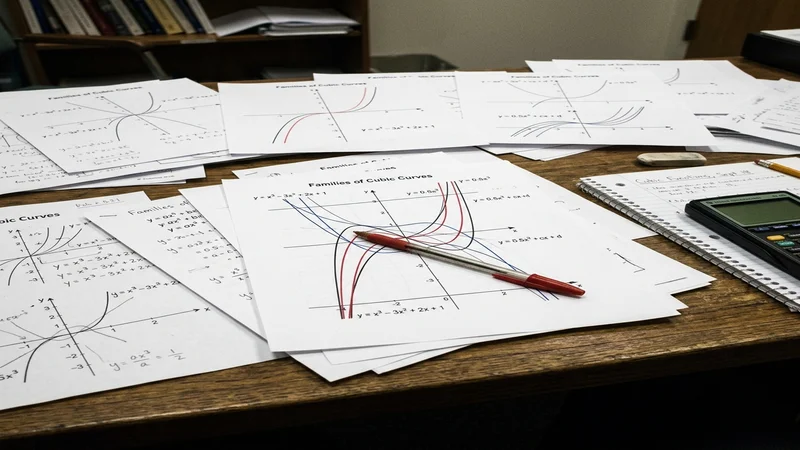
Because a parameter like can be any number from negative infinity to positive infinity, a parametric equation actually represents an infinite number of different graphs. This entire collection is called a “family.”
How do you find the inflection point of a parametric cubic?
Take the second derivative and set it to . (). The inflection point will often move left or right depending on the parameter.
(FAQs 16-60 cover advanced calculus interactions, eigenvalues in parametric matrices, Routh-Hurwitz stability bounds, handling simultaneous multi-parameters, geometric parameterization of curves, and historical notes on algebraic geometry).
Summary
A Parametric Cubic Equation represents the mathematical leap from static calculation to dynamic analysis.
By introducing a sliding parameter into the coefficients of a polynomial, mathematicians can model the chaotic, changing conditions of the physical world. Instead of simply finding a numerical answer, solving a parametric equation requires mapping the entire Discriminant to find the exact critical boundaries where roots transition from stable real numbers to unstable complex frequencies.
Whether you are an engineering student optimizing the weight-load of a steel truss, or an artificial intelligence researcher tweaking the learning rate of a neural network, mastering parametric manipulation gives you complete control over the mathematical universe.