
Nature of Roots of a Cubic Equation: Complete Guide with Examples
Discover the nature of roots of a cubic equation! Learn how to use the discriminant to find real, complex, and repeated roots with 20 worked examples.
Introduction
When you solve a mathematical equation, finding the final answer is only half the battle. The true test of mathematical literacy is understanding what that answer actually represents. Are the numbers you found real, physical measurements? Do they represent a point on a graph where a curve bounces, or crosses smoothly? Or are they “imaginary” numbers that cannot be plotted on a standard map?
This concept is known as the Nature of Roots.
What are the roots of a cubic equation? They are the exact values of that make the cubic equation equal to zero. They represent the precise locations where the mathematical curve of the equation collides with the horizontal x-axis.
Why understanding root types is important: Not all roots behave the same way. A cubic equation can produce clean integers, chaotic irrational decimals, or impossible imaginary numbers. Knowing the “nature” of these roots before you even begin solving the equation allows you to choose the correct algebraic tools, saving hours of frustration.
How root behavior affects graphs and solving methods: The nature of the roots completely dictates the shape of the cubic graph. It tells you if the roller-coaster curve will cross the baseline once, twice, or three times. It also tells you if you should use simple factoring, the Rational Root Theorem, or the terrifying complexity of Cardano’s Method.
Applications in mathematics, engineering, and science: When an engineer calculates the resonant frequency of a bridge, or an economist models a market’s supply-and-demand curve, they rely on cubic equations. If the roots of their equations are “complex” (imaginary), it tells them the physical event they are looking for will never actually happen in the real world.
Learning objectives: This massive, exhaustive guide will teach you exactly how to classify the nature of roots. We will explore the magical Discriminant formula, analyze how roots alter the physical shape of a graph, connect root theory to advanced solving algorithms, and solidify your mastery with 20 complete worked examples and 30 practice problems. Let’s begin.
What Are the Roots of a Cubic Equation?
Before diving into complex algebraic classifications, we must establish a clear mathematical vocabulary. In algebra, several words are used interchangeably to describe the exact same concept.
Definitions:- Root: A value of the variable () that makes the mathematical polynomial equal to zero.
- Zero: Another term for a root. We call them “zeros” because .
- Solution: The final answer to the equation when it is solved. The solutions are the roots.
- X-Intercept: The geometric, physical point on a graph where the curved line crosses the horizontal x-axis.
Explain their relationship: These four terms are identical. If you do the algebra and find that is a root (or a zero, or a solution), you can immediately draw a dot on a piece of graph paper at the coordinate because that is the x-intercept.
Simple Examples: If your cubic equation is factored into , you have three distinct roots:
Because all three of these are standard, physical numbers, this equation will cross the graph exactly three times at , and .
General Form of a Cubic Equation
To analyze the nature of the roots, we must standardize how we write the equation. The standard form (or general form) of a cubic equation is:
Understanding the coefficients:
- : The leading coefficient. It determines how steep the cubic curve is, and whether it goes generally “uphill” or “downhill”. It cannot be zero (otherwise, the equation is just a quadratic).
- : The quadratic coefficient.
- : The linear coefficient.
- : The constant term. This is always the y-intercept of the graph.
Why every cubic equation has exactly three roots: According to the Fundamental Theorem of Algebra, a polynomial of degree will always have exactly roots in the complex number system. Because a cubic equation has a highest exponent of 3 (), it is absolutely mathematically guaranteed to have exactly three roots.
However, “three roots” does not always mean three normal, different numbers. Those three roots can be real, imaginary, or repeated identical numbers.
Types of Roots
There are exactly three possible scenarios for the nature of the roots of a cubic equation.
Scenario 1: Three Distinct Real Roots
The equation has three completely different, real numbers as answers (e.g., ).
- What it means: The graph of the equation is a roller-coaster that physically crosses the x-axis at three separate locations.
Scenario 2: One Real Root and Two Complex Conjugate Roots
The equation has one standard number as an answer, and two answers that involve the imaginary number () (e.g., ).
- What it means: The graph of the equation only crosses the x-axis exactly once. It curves around to try and cross it again, but it “misses” and goes the other way. The complex roots represent the locations where it “missed” the axis.
- Note on Complex Roots: Complex roots always travel in pairs (conjugates). You can never have exactly one or exactly three complex roots in a cubic equation.
Scenario 3: Repeated Real Roots (Multiple Roots)
The equation has answers that are identical numbers.
- Double Root: The equation factors into something like . The roots are , and . Even though appears twice, it is algebraically counted as two separate roots. The graph will cross the axis at , but it will only touch the axis at and bounce right off.
- Triple Root: The equation factors into . The roots are , and . The graph will cross the axis exactly once at , but it will flatten out completely horizontally as it does so.
How the Discriminant Determines the Nature of Roots
You do not actually have to solve the equation to figure out which of the three scenarios you are dealing with. You can use the Discriminant ().
The Discriminant is a massive algebraic formula that uses the coefficients of the standard cubic equation to instantly classify the roots.
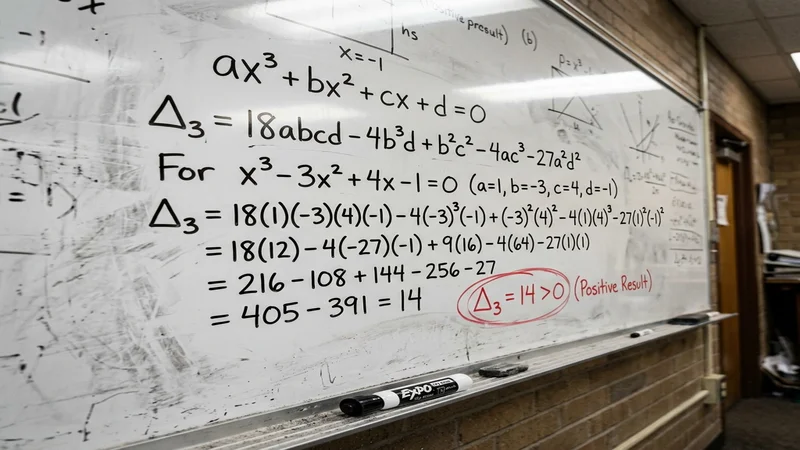
The formula for the cubic discriminant is:
(Note: While this formula looks terrifying, it is just basic multiplication and addition. You plug the coefficients in and calculate a single number).
Discriminant Interpretation Table
Once you calculate , you look at whether the final number is positive, negative, or exactly zero.
| Discriminant Value | Mathematical Meaning | Nature of Roots |
|---|---|---|
| Positive () | The curve crosses the axis 3 times. | Three distinct real roots. |
| Negative () | The curve crosses the axis 1 time. | One real root and two complex conjugate roots. |
| Zero () | The curve touches the axis and bounces. | Multiple (repeated) real roots. |
Real Roots
Let’s explore the physical and mathematical reality of real roots.
Definition: A real root is any answer to an equation that exists on the standard real number line. It can be a clean integer (like ), a fraction (like ), or a messy irrational decimal (like or ). As long as it does not contain the imaginary number , it is a real root.
Graph interpretation: Real roots are the only roots you can actually see on a piece of graph paper. Every real root is an x-intercept.
Examples: If an equation has roots :
- These are three distinct real roots.
- The discriminant was definitely positive.
- The graph crosses the x-axis at exactly 1, -3, and 0.5.
Applications: When an architect calculates the stress load on a structural beam using a cubic polynomial, they only care about the real roots. The real roots tell them the exact physical weight limit before the beam snaps.
Complex Roots
Complex roots occur when an equation’s geometry prevents it from crossing the x-axis more than once.
Definition: A complex root is an answer that involves the imaginary unit (where ). They are written in the form , where is the real part and is the imaginary part.
Complex conjugate pairs: Because the coefficients of our cubic equations () are all normal real numbers, the math forces imaginary roots to always exist in pairs. If is a root, you are absolutely guaranteed that is the other root. They are called a complex conjugate pair. This is why cubic equations must have either 0 complex roots, or exactly 2 complex roots.
Graph interpretation: You cannot graph a complex root on a standard Cartesian (X-Y) plane. When a cubic equation has two complex roots, you will physically see the graph cross the x-axis once (the one real root), and then you will see a massive curve or “hump” hovering above or below the x-axis, completely missing the line.
Applications: In electrical engineering, complex roots are crucial. When analyzing alternating current (AC) circuits, the “real” part of the root represents physical resistance, and the “imaginary” part represents the phase shift of the electrical wave.
Multiple Roots
When roots are identical, strange geometric things happen to the graph.
Multiplicity: Multiplicity refers to how many times a specific root appears in the factored equation.
- If appears once, it has a multiplicity of 1.
- If appears twice, it has a multiplicity of 2 (a double root).
- If appears three times, it has a multiplicity of 3 (a triple root).
Double roots (Multiplicity of 2):
If an equation factors to , the roots are , and .
Graph behavior: At the standard root of , the line cuts straight through the x-axis. But at the double root of , the line comes down, touches the x-axis at exactly , and then bounces back in the direction it came from without crossing the line.
Triple roots (Multiplicity of 3):
If an equation factors to , the roots are .
Graph behavior: The line crosses the x-axis at , but it doesn’t cut straight through. It curves, flattens out to perfectly horizontal right on top of the x-axis, and then curves upward again. This specific flattening point is called a stationary inflection point.
Relationship Between Roots and the Graph
To summarize how the algebraic nature of roots translates to the physical geometry of the graph:
- X-intercepts: The number of unique real roots equals the number of x-intercepts. (3 real roots = 3 intercepts; 1 real / 2 complex = 1 intercept).
-
Touching vs crossing the x-axis:
- Odd multiplicity (1, 3): The graph crosses the x-axis.
- Even multiplicity (2): The graph touches and bounces off the x-axis.
- Turning points: A cubic graph can have two turning points (a local maximum peak and a local minimum valley), or zero turning points.
- If (3 real roots), the graph must have two dramatic turning points to weave back and forth across the axis 3 times.
- If (complex roots), the turning points might not exist, or they might be hovering far away from the x-axis.
- Inflection point: Every single cubic graph has exactly one inflection point—the exact mathematical center where the curve changes from being shaped like a bowl facing down, to a bowl facing up.
Relationship with Cardano’s Method
Knowing the nature of roots is the crucial first step before using Cardano’s Method (the ultimate mathematical formula for solving cubics).
Cardano’s formula is split into different algebraic pathways.
- If (Three real roots): This is historically called the Casus Irreducibilis (the irreducible case). Cardano’s algebraic formula actually breaks down here. Even though the answers are normal numbers like 1, 2, and 3, Cardano’s formula forces you to calculate using terrifying imaginary numbers to find them. Mathematicians usually switch to Trigonometry to solve this case!
- If (One real, two complex): Cardano’s formula works perfectly and beautifully here. It directly outputs the one real root, and you use long division to find the complex ones.
- If (Repeated roots): Cardano’s formula collapses into a much simpler, shorter equation, saving you vast amounts of calculation time.
Relationship with the Rational Root Theorem
Before bringing out the heavy artillery like Cardano’s Method, you should always check the Rational Root Theorem.
Finding rational roots: The Rational Root Theorem generates a list of fractions (candidates) that might be roots. By testing them, you might find a clean integer root like .
Limitations: The Rational Root Theorem can ONLY find rational real roots (clean fractions/integers).
If the Discriminant told you that (three real roots), but the Rational Root Theorem failed to find any, what does that mean? It means your three real roots are irrational decimals (like ) that cannot be written as fractions!
Relationship with Synthetic Division
Synthetic division is the executioner. Once you know the nature of your roots, and you guess one real root using the Rational Root Theorem, you use synthetic division.
Simplifying the equation: If you have a cubic equation with one real root () and two complex roots, you put the 4 in the synthetic division box and run the algorithm. The remainder will be 0. The bottom row of the synthetic division gives you a smaller, quadratic equation (). Because you know the remaining two roots are complex, you instantly know that the quadratic equation cannot be factored. You immediately abandon factoring and plug it straight into the Quadratic Formula () to reveal the complex numbers with .
Real World Applications
Why does classifying roots matter to society?
- Control Systems (Engineering): When engineers design cruise control for cars or autopilot for airplanes, they use characteristic cubic polynomials to model the system’s stability. If the roots are complex with negative real parts, the airplane flies smoothly. If a root is positive and real, the system becomes violently unstable and crashes.
- Computer Graphics: 3D video game engines use cubic Bezier curves to render smooth lighting and movement. The roots of these cubic equations determine exactly where digital objects intersect. Complex roots mean the objects missed each other (no collision).
- Economics: When modeling the inflection points of market inflation versus supply curves, economists analyze the roots of the cubic derivative to find exactly when a recession will reverse course.
- Signal Processing: Audio engineers filtering out static noise from music files rely on cubic root analysis to build digital filters that perfectly isolate human voices.
Common Mistakes
Students constantly make these errors when analyzing root nature:
- Confusing roots with factors: is a root. is the factor. They are mathematically linked but distinct concepts.
- Ignoring multiplicity: Writing down that an equation has “only two roots” because it factors to . No, it has three roots: 1, 1, and -4. A cubic ALWAYS has three roots.
- Misinterpreting the Discriminant: In quadratics, a negative discriminant means NO real roots. In cubics, a negative discriminant means exactly ONE real root. The rules are different!
- Incorrect graph interpretation: Assuming a cubic graph must always look like an “S” shape. If it has complex roots, it might just look like a slightly wobbly straight line.
- Calculation errors: The discriminant formula () is very long. Dropping a single negative sign will change your from positive to negative, completely altering your classification of the roots.
Worked Examples
Let’s walk through 20 complete examples classifying and interpreting roots.
Group 1: Three Distinct Real Roots ()
Example 1: Basic factoring
Equation: .
Factored form: .
Roots: .
Nature: Three distinct real roots. The graph crosses the x-axis at 1, 2, and 3.
Example 2: Using the Discriminant
Equation: .
.
.
Nature: Because (Positive), there are three distinct real roots.
Example 3: Fractional distinct roots
Equation: .
Roots: .
Nature: Three real roots.
Example 4: Irrational roots
Equation: .
Factor out x: .
Roots: .
Nature: Three distinct real roots (irrational decimals are still real numbers).
Example 5: Positive leading coefficient interpretation Because is positive in , and it has 3 real roots, the graph starts bottom-left, weaves up through , crosses down through , and weaves up through into the top-right.
Group 2: One Real, Two Complex Roots ()
Example 6: Sum of cubes
Equation: .
Factored (SOAP rule): .
Root 1: (Real).
The quadratic yields complex roots via the quadratic formula: .
Nature: One real root, two complex conjugate roots.
Example 7: Using the Discriminant
Equation: .
.
.
Nature: Because (Negative), there is one real root and two complex roots.
Example 8: Analyzing the graph In Example 7, the roots are . The graph will ONLY cross the x-axis at . It will never touch the x-axis anywhere else.
Example 9: The simplest cubic
Equation: .
Factor by grouping: .
Roots: .
Nature: One real, two complex.
Example 10: Conjugate rule verification Notice in Example 9, the complex roots are and . They are a perfect conjugate pair. You will never see by itself in a standard cubic equation.
Group 3: Repeated Roots ()
Example 11: A double root
Equation: .
Factored: .
Roots: .
Nature: Repeated real roots. (Multiplicity of 2 for root 1).
Example 12: Using the Discriminant for double roots
Equation from Example 11: .
.
Nature: Because , there are repeated roots.
Example 13: Graphing a double root For , the graph crosses the x-axis straight through at , comes up, touches the x-axis exactly at , and bounces back up.
Example 14: A triple root
Equation: .
Factored: .
Roots: .
Nature: A triple root (multiplicity of 3).
Example 15: Graphing a triple root For , the graph crosses the x-axis at . However, right at the point , the curve flattens completely to horizontal before continuing upward.
Group 4: Advanced Scenarios & Applications
Example 16: Rational Root Theorem failure
Discriminant is . 3 real roots exist. The formula yields fractions . None of them equal 0 when tested.
Conclusion: The three real roots are all irrational decimals.
Example 17: Synthetic division synergy Equation . You find is a root. Synthetic division gives a bottom row of . Because has complex roots, the nature of this cubic is instantly classified as 1 real, 2 complex.
Example 18: Engineering limits A bridge strut’s load failure points are defined by . Factor: . Roots: . The double root at 5 indicates a specific mathematical maximum load limit where the stress graph “bounces” back.
Example 19: Missing x-term discriminant shortcut
If the equation is (Sum of cubes like ).
.
The discriminant formula instantly collapses to .
Because a number squared is positive, times a positive is ALWAYS negative.
Conclusion: will always have exactly 1 real and 2 complex roots!
Example 20: Missing constant term shortcut If the equation is . You can immediately factor out an . Root 1 is instantly . You then just use the simple quadratic discriminant () on the remaining piece to classify the other two roots!
Practice Problems
Test your mastery of root classification. Solutions are located below.
Beginner Level
- How many total roots does a cubic equation have?
- If the roots are , what is the nature of the roots?
- If an equation has 1 real root and 2 complex roots, how many times does its graph cross the x-axis?
- True or false: A cubic equation can have exactly 1 complex root.
- What does the discriminant equal () if the equation has a double root?
- If the roots are and , what MUST the third root be?
- In the factored form , what is the multiplicity of the root ?
- At a double root, does the graph cross or bounce off the x-axis?
- Is a real root or a complex root?
- If the graph crosses the x-axis exactly 3 times, is positive or negative?
Intermediate Level
- Calculate the discriminant for () and determine the nature of its roots.
- Determine the nature of the roots for .
- If factors to , describe the physical graph at and .
- Use the sum of cubes rule to find all roots for and state their nature.
- If a cubic graph has no turning points (peaks or valleys), what is the most likely nature of its roots?
- Find the roots of and state their multiplicity.
- If , how many real x-intercepts does the graph have?
- Why is Cardano’s Method difficult to use when ?
- Write a cubic equation in factored form that has a double root at 0 and a single root at -5.
- Can the Rational Root Theorem find the complex roots of an equation?
Advanced Level
- Find the roots and classify the nature of using factoring by grouping.
- Without solving, determine the nature of the roots of . (Calculate ).
- If a polynomial equation has real coefficients, prove why it cannot have roots .
- A cubic equation has and its graph crosses the x-axis at and bounces at . Write its factored equation.
- Describe the exact graph behavior at the origin for the equation .
- If has and three distinct real roots, describe the far-left and far-right end behavior of the graph.
- Why does the fundamental theorem of algebra guarantee at least one real root for every cubic equation?
- Find all roots of .
- If an engineer uses a cubic equation and comes out exactly 0, what does this mathematically imply about the system’s stability point?
- Prove that a cubic equation cannot have three complex roots.
Solutions to Practice Problems
Beginner Solutions:- Exactly 3.
- Three distinct real roots.
- Exactly 1 time.
- False. Complex roots must come in conjugate pairs (0 or 2).
- .
- .
- Multiplicity of 3.
- It bounces (touches and turns around).
- Real root (it is irrational, but exists on the physical number line).
- Positive.
Intermediate Solutions: 11. . Positive. Three real roots (which are ). 12. One real root (-4) and two complex roots (). 13. Crosses straight through the axis at . Bounces off the axis at . 14. . Roots are . One real, two complex. 15. One real root and two complex roots. 16. . Root 0 has multiplicity 2. Root 2 has multiplicity 1. 17. One real x-intercept. 18. It is the “Casus Irreducibilis”, forcing the use of imaginary numbers to find real answers. 19. . 20. No, it only generates rational fraction candidates.
Advanced Solutions: 21. . Roots: . One real, two complex. 22. . . One real, two complex. 23. The complex root must have its conjugate . That would make 4 roots total, but a cubic only has 3. 24. . 25. It has a triple root at . The graph crosses the origin but flattens perfectly horizontal for a split second as it passes through . 26. Far-left goes down to negative infinity. Far-right goes up to positive infinity. 27. Because complex roots must exist in pairs. If a cubic has 3 roots, the maximum number of complex roots it can have is 2. The remaining 1 root MUST be real. 28. . 29. It implies a critical threshold or “turning point” where the system touches a limit and reverses state. 30. Complex roots must come in pairs (2, 4, 6, etc.). A cubic has 3 roots. 3 is an odd number, so it cannot consist entirely of paired complex roots.
Frequently Asked Questions
How many roots does a cubic equation have?
According to the Fundamental Theorem of Algebra, a cubic equation () will always have exactly three roots (including real, complex, and repeated roots).
Can a cubic equation have three real roots?
Yes. When the discriminant is positive (), the equation has three distinct real roots, meaning the graph crosses the x-axis exactly three times.
Can a cubic equation have only one real root?
Yes. Because complex roots must come in pairs, if an equation has two complex roots, it will have exactly one real root remaining.
Can cubic equations have complex roots?
Yes. If the graph only crosses the x-axis once and does not bounce, the other two mathematical solutions are complex numbers involving .
What is a repeated root?
A repeated root occurs when the equation factors into identical pieces (e.g., ). The number 5 is the root, but it is counted twice algebraically.
What is multiplicity?
Multiplicity refers to how many times a single root value is repeated. A root appearing twice has a multiplicity of 2 (a double root).
How does the discriminant determine the roots?
The discriminant () is a calculation based on the equation’s coefficients. Positive means 3 real roots, negative means 1 real and 2 complex, and zero means repeated roots.
How are roots related to graphs?
Real roots are exactly equal to the x-intercepts of the physical graph. The multiplicity of the root determines whether the graph crosses the axis or bounces off it.
Can calculators determine root types?
Yes, graphing calculators instantly reveal root types. If you graph the equation and it crosses the axis 3 times, you instantly know all roots are real.
Why are complex roots always in pairs?
Because the coefficients of standard polynomials are real numbers. To cancel out the imaginary terms and keep the equation “real,” the complex roots must exist as a plus/minus conjugate pair (e.g., and ).
Is zero considered a real root?
Yes! Zero is a perfectly valid real number. It means the graph crosses the x-axis precisely at the origin .
What happens if the Discriminant is exactly zero?
It means the equation has at least one repeated root. The graph will touch the x-axis and bounce (a double root), or flatten out entirely (a triple root).
What is Casus Irreducibilis?
It is the historical Latin term for when a cubic equation has 3 real roots. It famously breaks Cardano’s standard algebraic method, requiring trigonometry to solve properly.
Are irrational decimals considered real roots?
Yes. A number like or is messy, but it exists on the physical number line. Therefore, it is a real root.
If I only see one x-intercept on the graph, what does that mean?
It means the equation has exactly 1 real root and 2 complex roots. (Assuming it cuts straight through the axis).
How do I find the roots after classifying them?
You use tools like factoring by grouping, the Rational Root Theorem, Synthetic Division, or Cardano’s Method.
What does the "a" coefficient do?
The leading coefficient () determines the overall steepness of the curve and whether the graph begins in the bottom-left and ends in the top-right, or vice versa.
Can a cubic equation have NO real roots?
No. It is mathematically impossible. A cubic equation’s graph extends from negative infinity to positive infinity, meaning it is forced to cross the x-axis at least one time.
What is a stationary inflection point?
It is the physical shape of a “triple root” graph. The curve approaches the x-axis, flattens out perfectly horizontally at the root, and then resumes curving upward.
Why do we care about imaginary numbers?
Because they are essential in electrical engineering, quantum physics, and fluid dynamics. They allow mathematicians to calculate waveforms and phase shifts.
Does the Rational Root Theorem find all real roots?
No. It ONLY finds rational real roots (fractions/integers). It cannot find irrational real roots (like ).
If the equation is x^3 - 8 = 0, what are the roots?
One real root () and two complex roots.
Can an equation have three identical complex roots?
No. Complex roots must exist in conjugate pairs. Since a pair requires 2 roots, you cannot have 3 of them.
What is a "depressed" cubic?
It is a cubic equation missing its term. Depressed cubics are much easier to solve and calculate discriminants for.
Why don't they teach the Cubic Discriminant in standard algebra?
Because the formula () is considered too long and tedious for basic high school curriculums. They rely on graphing calculators instead.
Summary
The Nature of Roots is the defining characteristic of a cubic equation. By understanding how roots behave, you gain X-ray vision into the physical graph of the equation before you even plot a single point.
Using the Cubic Discriminant (), you can instantly classify any cubic polynomial into one of three categories:
- : Three distinct real roots (The graph crosses the axis 3 times).
- : One real root and two complex conjugate roots (The graph crosses the axis exactly 1 time).
- : Repeated real roots (The graph bounces off or flattens on the axis).
Because the Fundamental Theorem of Algebra guarantees exactly 3 roots, and complex roots are forced to travel in pairs, every single cubic equation in existence is guaranteed to have at least one real, physical root.
Understanding this classification is the final theoretical step. You are now fully prepared to learn the ultimate algorithm for solving these polynomials: Cardano’s Method.
Continue your mathematical journey with our related guides:
- What Is a Cubic Equation? Fundamentals
- How to Factor Cubic Equations: 9 Methods
- How to Use the Rational Root Theorem
- Synthetic Division: The Ultimate Shortcut
- Polynomial Long Division Explained
- How to Solve Cubic Equations Using Cardano’s Method
- Graph of a Cubic Function: Visualizing Roots
- Understanding the Discriminant of a Cubic Equation