
Descartes' Rule of Signs: Complete Guide with Examples
Master Descartes' Rule of Signs! Learn how to predict the exact number of positive and negative roots in any polynomial with 20 step-by-step worked examples.
Introduction
Before computers were invented, solving a massive fifth-degree or sixth-degree polynomial equation was a nightmare. Mathematicians had to guess numbers, plug them in, and hope the math equaled zero. If they tested the numbers 1, 2, 3, 4, and 5, and none of them worked, they had a terrifying question to answer: Should I keep testing positive numbers, or are all the answers actually negative numbers?
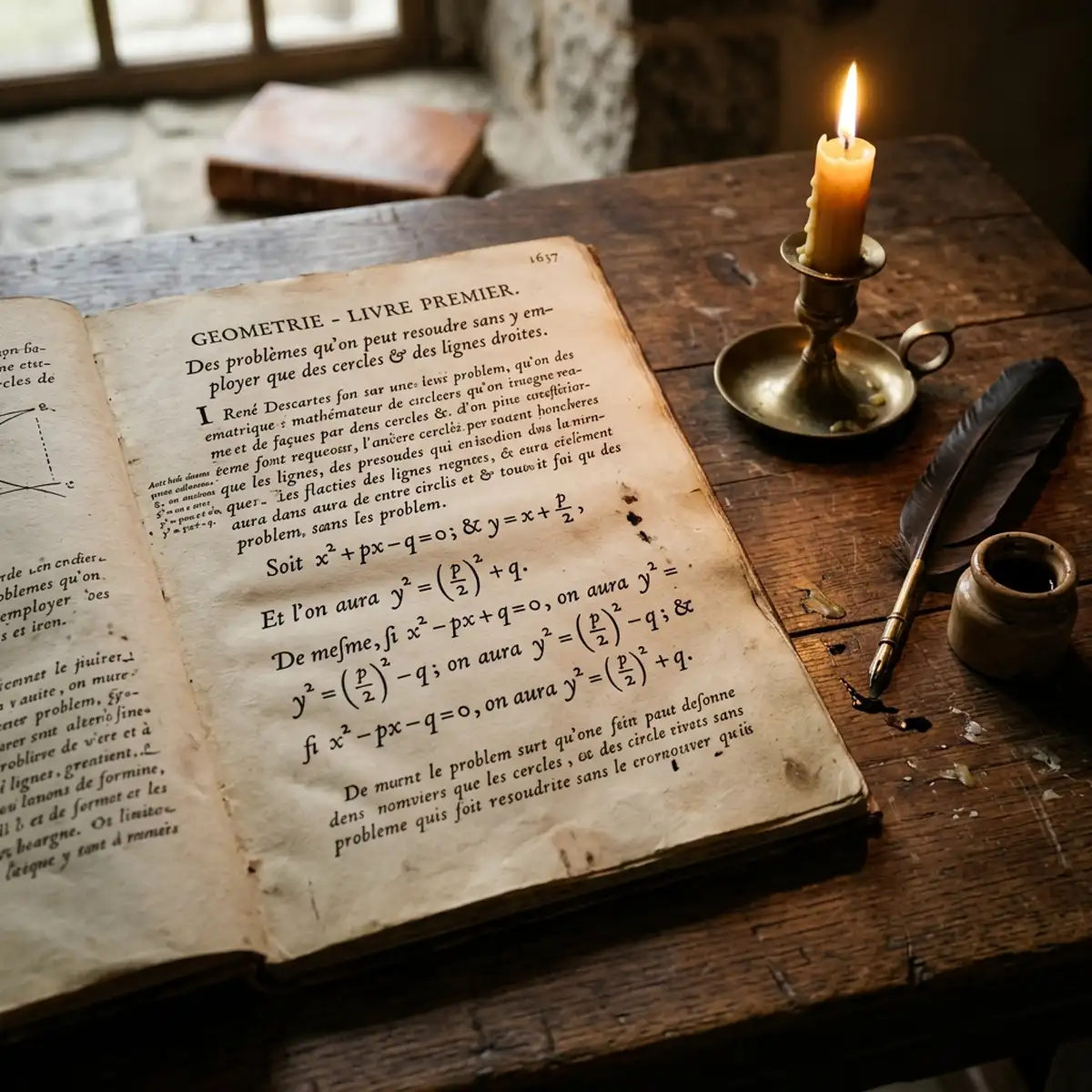
In 1637, a brilliant philosopher and mathematician provided the ultimate shortcut to answer that exact question: Descartes’ Rule of Signs.
What Descartes’ Rule of Signs is: It is a mathematical theorem that allows you to instantly predict the maximum number of positive real roots, and negative real roots, hidden inside a polynomial—without actually having to solve the equation.
Why it is useful: It acts as a compass. If the rule tells you that an equation has exactly zero positive roots, you instantly know that you should never waste your time testing positive numbers. You must only test negative numbers.
How it predicts roots: It works purely by observing the algebraic signs (pluses and minuses) attached to the numbers in the equation. By simply counting how many times the signs flip from positive to negative, the rule generates a precise tally of the possible root combinations.
Its role in solving cubic equations: When solving cubic equations, knowing if the answers will be positive or negative severely limits the amount of manual work you must do when using the Rational Root Theorem or Synthetic Division.
Learning objectives: This massive, exhaustive guide will teach you exactly how to execute Descartes’ Rule of Signs. We will explore how to substitute to find negative roots, understand why the root count always decreases by two, connect it to the Discriminant, and solidify your mastery with 20 complete worked examples and 30 practice problems. Let’s begin.
Who Was René Descartes?
To appreciate the rule, we must appreciate the man who invented it.
A brief historical background: René Descartes (1596–1650) was a French philosopher, scientist, and mathematician. You likely know him for his famous philosophical quote, “I think, therefore I am” (Cogito, ergo sum).
His contribution to mathematics: Beyond philosophy, Descartes is considered the father of analytical geometry. He invented the Cartesian coordinate system—the standard X-Y graph with a horizontal and vertical axis that you use in every single algebra class. Before Descartes, algebra and geometry were completely separate subjects. He proved that algebraic equations could be drawn as physical geometric shapes.
Why the rule is named after him: In 1637, he published a revolutionary text called La Géométrie, where he formalized the use of exponents () and published this exact rule for analyzing the signs of polynomials. It was the first time in history anyone had proved that the physical plus/minus signs of an equation directly controlled the physical graph of the equation.
What Is Descartes’ Rule of Signs?
Let’s strip away the historical context and look at the raw mathematics.
State the rule clearly: Descartes’ Rule of Signs states two things about a polynomial arranged in standard descending order:
- The number of positive real roots is either equal to the number of sign changes between consecutive coefficients, or is less than that number by an even integer (2, 4, 6…).
- The number of negative real roots is either equal to the number of sign changes in , or is less than that number by an even integer.
An intuitive explanation: Look at an equation. Count how many times the numbers switch from to (or to ) as you read it from left to right. That count tells you the maximum number of positive answers the equation can have. But because complex imaginary roots can “steal” answers away in pairs of two, the true number of positive answers might be less than your count by exactly 2, or 4, or 6.
Defining the Vocabulary
- Polynomial: An algebraic expression with variables and exponents (e.g., ).
- Positive root: A solution to the equation that is a positive number (like or ). The graph crosses the right side of the x-axis.
- Negative root: A solution that is a negative number (like or ). The graph crosses the left side of the x-axis.
- Sign change: When a positive term is immediately followed by a negative term, or vice versa, ignoring any missing terms.
- Coefficient: The specific numerical value attached to the variable (the in ).
Understanding Sign Changes
Before applying the rule, you must know how to properly count.
How to count sign changes: Write the polynomial in standard descending order (, constant). Look at the plus or minus sign attached to each term. Count exactly how many times the sign “flips.”
Simple Example 1:
- Term 1 to Term 2: to . (That is 1 flip).
- Term 2 to Term 3: to . (That is 2 flips).
- Term 3 to Term 4: to . (That is 3 flips).
Total Sign Changes: 3.
Simple Example 2:
- Term 1 to Term 2: to . (No flip).
- Term 2 to Term 3: to . (That is 1 flip).
- Term 3 to Term 4: to . (No flip).
Total Sign Changes: 1.
Comparison Table
| Polynomial | Sign Sequence | Number of Flips | Result |
|---|---|---|---|
| 0 | 0 sign changes | ||
| 2 | 2 sign changes | ||
| 3 | 3 sign changes | ||
| 1 | 1 sign change |
(Note: In the last row, , we completely ignore the missing , and terms. We only count the terms that are physically present).
Predicting Positive Real Roots
The number of sign changes you just counted is the magic number.
How to count positive roots: The maximum number of positive real roots is exactly equal to the number of sign changes in .
Possible reductions by even numbers: Because polynomials can have complex (imaginary) roots, and complex roots always travel in pairs, they can steal roots away from your real count, but only in multiples of 2. Therefore, if you counted 3 sign changes, the number of positive real roots is 3, or 1. (You subtract 2). If you counted 4 sign changes, the number of positive roots is 4, or 2, or 0. If you counted 1 sign change, the number of positive roots is exactly 1. (You cannot subtract 2, because you cannot have a negative amount of roots).
Worked Example:
Predict the positive roots of .
Signs:
Flips: to (1). to (0). to (2). to (3).
Total Flips: 3.
Conclusion: This equation has either 3 positive real roots, or 1 positive real root. It is mathematically impossible for it to have 2, 4, or 0 positive roots.
Predicting Negative Real Roots
To find the negative roots, the rule requires a little bit of algebra first. You cannot just count the signs of the original equation.
Replacing with : You must create a new polynomial called . You do this by plugging into every variable in the equation. Because a negative number squared becomes positive, and a negative number cubed remains negative, the rule is simple: Flip the signs of every term with an ODD exponent. Keep the signs of the even exponents and the constant exactly the same.
Counting sign changes again: Once you have the new equation, you simply count the sign flips exactly as you did before.
Worked Example: Predict the negative roots of .
- Flip the signs of the odd exponents ( and ): .
- Count the new signs:
- Flips: to (0). to (1). to (0).
- Total Flips: 1.
Conclusion: This equation has exactly 1 negative real root.
Why the Rule Works
Why do physical plus and minus signs control the geometry of roots?
A beginner-friendly explanation: Think about what happens when an equation is fully factored, like . The roots are positive 2, positive 3, and positive 4. If you multiply those three factors together using algebra, the constant term will be . Notice how multiplying negative factors (which yield positive roots) forces the algebraic signs in the expanded polynomial to flip back and forth between positive and negative! Descartes realized this algebraic expansion property was a universal law.
Mathematical intuition: Every time you introduce a new positive root into an equation, you are essentially multiplying the entire polynomial by a new factor. Algebraically, multiplying by forces the terms to shift and overlap in a way that introduces exactly one new alternating sign change into the final expanded polynomial.
Step by Step Method
Here is the flawless, mechanical workflow for executing Descartes’ Rule of Signs on any polynomial.
Step 1: Write the polynomial in standard form
Ensure the equation is written in descending order of exponents, and set equal to zero. (e.g., ). Ignore any missing terms (do not write ).
Step 2: Count positive sign changes
Read the signs from left to right. Tally every time the sign flips from to or to .
Step 3: Interpret positive roots
Write down the total count. Then, subtract 2 repeatedly until you hit 1 or 0. This list of numbers is your possible positive real roots.
Step 4: Substitute negative
Create by flipping the sign of every coefficient attached to an odd exponent (). Leave the even exponents () and the constant completely alone.
Step 5: Count negative sign changes
Read the signs of the newly created equation from left to right. Tally the flips.
Step 6: Interpret negative roots
Write down the total count. Subtract 2 repeatedly until you hit 1 or 0. This list is your possible negative real roots.
Step 7: Verify using solving methods
Because Descartes only gives you possibilities (e.g., 3 or 1), you must use tools like the Rational Root Theorem and Synthetic Division to test numbers and find the exact, true root count.
Descartes’ Rule of Signs and Cubic Equations
Because cubic equations () have exactly 3 roots total, Descartes’ Rule forms very specific, predictable patterns.
Three real roots: If has 3 sign changes, and has 0 sign changes. Conclusion: The cubic has 3 positive roots, or 1 positive root. It has 0 negative roots. Therefore, the roots are either (3 Positive, 0 Negative) OR (1 Positive, 0 Negative, 2 Complex).
One real root: If has 1 sign change, and has 0 sign changes. Conclusion: The cubic has EXACTLY 1 positive root. Because , and a cubic must have 3 roots, the remaining 2 roots are mathematically forced to be complex imaginary numbers!
Repeated roots: Descartes’ rule counts repeated roots as separate entities. If is a double root, Descartes counts it as TWO positive roots toward its tally.
Relationship with Other Solving Methods
Descartes’ Rule is a diagnostic tool. It does not give you the answers; it tells you where to look for the answers.
| Solving Method | How Descartes’ Rule Helps It |
|---|---|
| Rational Root Theorem | The Rational Root Theorem gives you a massive list of candidates. Descartes’ rule can instantly eliminate half the list (e.g., if Descartes says 0 negative roots, throw away all negative candidates!). |
| Synthetic Division | Tells you whether to start synthetically dividing by positive integers or negative integers first. |
| Discriminant | The Discriminant tells you the total number of real roots (3 or 1). Descartes tells you exactly how many of them are positive vs negative. |
| Cardano’s Method | If Descartes proves 1 real root and 2 complex roots, it verifies that Cardano’s formula will work perfectly without hitting the Casus Irreducibilis. |
Advantages and Limitations
What the rule can predict:- The absolute maximum number of positive and negative real roots.
- Cases where an equation has exactly ZERO positive or negative roots, saving immense amounts of calculation time.
- The exact number of complex roots (by subtracting the maximum real roots from the total degree).
- The exact, actual numbers. It tells you there is 1 positive root, but it cannot tell you if that root is or .
- Exact certainty when the tally is . (If it says “3 or 1”, you still don’t know for sure which scenario is reality until you solve it).
Common misconceptions: Some students think that if a polynomial is entirely positive (), it must have positive roots. The exact opposite is true. There are 0 sign changes. Therefore, it has ZERO positive roots. The answers must be negative or complex!
Common Mistakes
Avoid these pitfalls when executing the rule:
- Counting sign changes incorrectly: Misreading as a sign change. No flip occurred.
- Ignoring zero coefficients: Actually, you should ignore them! Some students try to write and count it as a sign. Zeros have no sign. Skip over them entirely.
- Misinterpreting possible root counts: Counting 4 sign changes and saying “It has 4 roots.” It might have 4, but it could also have 2, or 0. You must include the reductions.
- Forgetting to substitute negative correctly: When making , students accidentally flip the signs of or the constant. Only flip the signs of odd exponents!
- Calculation errors: Making a tiny mistake in the substitution phase ruins the negative root tally entirely.
Worked Examples
Let’s walk through 20 complete classification examples.
Group 1: Simple Cubics
Example 1: All positive terms . Positive roots: Signs . Flips: 0. Positive roots: 0. Negative roots: Flip odd exponents . Signs . Flips: 3. Negative roots: 3 or 1.
Example 2: Alternating signs . Positive roots: Signs . Flips: 3. Positive roots: 3 or 1. Negative roots: Flip odd exponents . Signs . Flips: 0. Negative roots: 0.
Example 3: Missing term . Positive roots: Signs . Flips: 1. Positive roots: Exactly 1. Negative roots: Flip odd exponents . Signs . Flips: 0. Negative roots: 0. (Since total roots = 3, the remaining 2 roots must be complex!).
Example 4: Missing constant . Factor out : . Root is neither positive nor negative. Apply Descartes to : Positive: Flips. Positive roots: 2 or 0. Negative: Flips. Negative roots: 0.
Example 5: Negative leading coefficient . Positive: Flips. Positive roots: 2 or 0. Negative: Flip. Negative roots: Exactly 1.
Group 2: Higher Degree Polynomials
Example 6: Quartic (4th degree) . Positive: Flips. Positive roots: 3 or 1. Negative: Flip. Negative roots: Exactly 1.
Example 7: Quintic (5th degree) . Positive: Flips. Positive roots: 3 or 1. Negative: Flips. Negative roots: 2 or 0.
Example 8: Complete Complex Case . Positive: Flips. Positive: 0. Negative: Flips. Negative: 0. Conclusion: All 4 roots are complex imaginary numbers!
Example 9: Massive jumps . Positive: Flip. Positive: Exactly 1. Negative: Flips. Negative: 0. (Root exists too. The other 4 roots are complex).
Example 10: Eliminating candidates If . Positive: Flip. Positive: Exactly 1. Negative: Flips. Negative: 3 or 1.
Group 3: Real World Application Scenarios
Example 11: Rational Root Synergy . Descartes shows 0 Positive roots. The Rational Root theorem candidates are . You can instantly throw away and . You only have to test and .
Example 12: Repeated Roots verification . (This factors to ). Positive: Flips. Positive: 3 or 1. Negative: Flips. Negative: 0. The rule perfectly accommodated the triple positive root at .
Example 13: Discriminant Synergy . Discriminant is positive (3 real roots). Descartes Positive: Flips. (2 or 0). Descartes Negative: Flip. (1). Because guarantees 3 real roots, we know the “2 or 0” MUST be 2. Conclusion: Exactly 2 positive roots, 1 negative root.
Example 14: The 0 root anomaly . Factor out : . Root has multiplicity 3. Remaining equation : 1 Positive flip, 1 Negative flip. 1 Positive root, 1 Negative root, and the root 0.
Example 15: Solving physics limits An engineer has a formula . Positive Flips: Flip. The engineer instantly knows there is exactly 1 positive velocity limit, so they don’t have to search for a second one.
Group 4: Advanced Practice
Example 16: Sixth degree . Positive: Flips. Positive: 6, 4, 2, or 0. Negative: Flips. Negative: 0.
Example 17: Out of order equations . MUST rewrite standard: . Positive: Flips. (3 or 1). Negative: Flips. (0).
Example 18: Decimal coefficients . Positive: Flips. (2 or 0). Negative: Flip. (Exactly 1).
Example 19: All negative terms . Positive: Flips. (0). Negative: Flips. (3 or 1).
Example 20: Irreducible quadratic leftover . Positive: Flips. (3 or 1). Negative: Flips. (0). (It factors to . The true answer is 1 positive root and 2 complex roots, which Descartes perfectly predicted as a possibility).
Practice Problems
Test your mastery of Descartes’ Rule of Signs. Solutions are provided below.
Beginner Level
- How many positive sign changes are in ?
- How many positive sign changes are in ?
- If an equation has 3 positive sign changes, what are the possible numbers of positive real roots?
- If an equation has 1 positive sign change, what is the exact number of positive real roots?
- True or false: You must write the equation in standard descending order before counting signs.
- To find negative roots, you substitute . Which exponents get their signs flipped?
- Count the negative sign changes for .
- Does Descartes’ Rule tell you the exact value of the root?
- If an equation has 0 sign changes, how many positive roots does it have?
- Can a cubic equation have exactly 2 positive roots and 1 negative root?
Intermediate Level
- Determine the possible number of positive and negative roots for .
- Determine the possible number of positive and negative roots for .
- If , determine the positive and negative roots.
- Why do we decrease the root count by exactly 2 (e.g., 4, 2, 0)?
- Analyze for positive and negative roots.
- A cubic equation has 0 positive roots and 1 negative root. What are the other two roots?
- If you use the Rational Root Theorem and Descartes’ rule tells you there are 0 negative roots, what do you do with your list?
- Analyze for positive and negative roots.
- Reorder and analyze .
- True or false: Descartes’ rule works on equations with complex coefficients (like ).
Advanced Level
- A quintic (5th degree) equation has 5 positive sign flips and 0 negative sign flips. What are all the possible root combinations (Positive, Negative, Complex)?
- Prove that (where is an even number) has exactly one positive root and exactly one negative root.
- Analyze . Based on Descartes, is it possible for all roots to be real?
- If for a cubic equation, and Descartes yields (2 or 0) positive roots and (1) negative root, exactly how many positive roots are there?
- Analyze . Explain the results.
- If a polynomial has only even exponents (), what will look like?
- Analyze .
- An engineer writes . They need a negative velocity. Using Descartes, is this physically possible?
- Describe how a multiple (repeated) root like interacts with Descartes’ positive root count.
- Prove why an equation with all positive coefficients can never have a positive real root.
Solutions to Practice Problems
Beginner Solutions:- 1 change ().
- 4 changes.
- 3 or 1.
- Exactly 1.
- True.
- Odd exponents ().
- 0 changes.
- No, it only tells you the maximum possible quantity of roots.
- Exactly 0.
- Yes ().
Intermediate Solutions: 11. Positive: flips (2 or 0). Negative: flip (1). 12. Positive: 0 flips (0). Negative: flips (3 or 1). 13. Positive: flip (1). Negative: flip (1). 14. Because complex imaginary roots must always exist in pairs (conjugates). They steal real roots two at a time. 15. Positive: flips (3 or 1). Negative: flips (0). 16. They must be complex imaginary roots. 17. Cross out every negative fraction on the list. Only test the positive ones. 18. Positive: 0. Negative: . (Root exists, the other 4 are complex). 19. Reordered: . Positive: flip (1). Negative: flips (2 or 0). 20. False. It only applies to polynomials with real-number coefficients.
Advanced Solutions: 21. (5 Pos, 0 Neg, 0 Comp), OR (3 Pos, 0 Neg, 2 Comp), OR (1 Pos, 0 Neg, 4 Comp). 22. : Positive flips: 1. Negative: Since is even, . So . Negative flips: 1. Exactly 1 pos, 1 neg. 23. Positive: 4, 2, or 0. Negative: . Since negative is 0, if positive is 0 or 2, complex roots must exist. Yes, it is possible for all to be real (if positive is 4). 24. Exactly 2. ( means all 3 roots are real. So the “0” option is impossible). 25. Positive: . Negative: . Exactly 1 positive real root, 2 complex roots. 26. It will look identical to . . (Meaning positive root count = negative root count = 0). 27. Positive: 0. Negative: . Roots are 0 and 4 complex numbers. 28. Positive: flips. Negative: flips. No, a negative velocity is mathematically impossible. 29. Descartes counts a root of multiplicity 2 as two separate positive roots. 30. If you plug any positive number into an equation where all terms are positive and added together, the result will always be a massive positive number. It can never equal 0.
Real World Applications
Why is an ancient 17th-century rule still used today?
- Scientific Computing & Algorithms: Modern computer programs that find roots (like those in Python or MATLAB) use Descartes’ Rule of Signs behind the scenes. Before the computer runs a heavy, million-cycle numerical approximation, it checks Descartes’ rule. If the rule says “0 positive roots,” the computer restricts its search parameters to negative numbers, cutting processing time in half.
- Control Systems Engineering: When analyzing the stability of robotics or airplane auto-pilots, engineers look at a “characteristic polynomial.” If Descartes’ rule proves that there is even one positive real root, the system is classified as mathematically unstable and physically dangerous.
- Economics: When finding the equilibrium point where supply matches demand, economists generate high-degree polynomials. Since “negative prices” or “negative goods produced” do not exist in reality, Descartes’ rule instantly verifies if a valid, positive real-world economic model is possible.
Frequently Asked Questions
What is Descartes' Rule of Signs?
It is a mathematical theorem that predicts the maximum number of positive and negative real roots a polynomial equation can have by counting the algebraic sign changes.
How do you count sign changes?
Read the polynomial from left to right in descending order. Count exactly how many times a positive term is followed by a negative term, or vice versa.
Can the rule find exact roots?
No. It only provides a tally of the possibilities (e.g., 3 or 1). It does not tell you if the root is or .
Can it predict complex roots?
Yes, indirectly. If a cubic equation has a degree of 3, and Descartes proves it has 0 positive and 1 negative root, the remaining 2 roots must mathematically be complex imaginary numbers.
How accurate is Descartes' Rule of Signs?
It is 100% mathematically accurate. The true number of roots will always match the possibilities generated by the rule.
Can it be used for cubic equations?
Absolutely. It is the fastest way to analyze a cubic equation before attempting to use factoring or Cardano’s Method.
Can a polynomial have zero positive roots?
Yes. If all the terms in the polynomial are positive (), there are 0 sign changes, meaning 0 positive roots.
Why do possible root counts decrease by two?
Because complex imaginary roots must always exist in “conjugate pairs” (like and ). They can only steal real roots away from the total in groups of two.
How does it relate to the Rational Root Theorem?
The Rational Root Theorem generates a massive list of both positive and negative fractions. Descartes’ rule lets you instantly cross off half the list if it predicts 0 positive or 0 negative roots.
Can calculators apply Descartes' Rule of Signs?
Advanced computer algebra systems (CAS) use it internally to speed up calculations, but standard graphing calculators rely on plotting the physical line rather than algebraic rules.
What if a polynomial is missing an x^2 term?
Simply ignore it. Do not write . Count the signs of the terms that physically exist.
How do I find negative roots again?
Create by flipping the plus/minus sign of every term that has an odd exponent (). Then count the sign changes of that new equation.
Why don't I flip the sign of the constant term?
Because the constant term mathematically has an exponent of . Since 0 is an even number, remains positive .
What if the equation is not set to zero?
You MUST set it to zero and combine all like terms before you count the signs. ( must become ).
Does x=0 count as a positive or negative root?
Neither. Zero has no sign. If you factor out an (e.g., ), is a root, and you apply Descartes to the remaining .
Is it Descartes's or Descartes'?
Grammatically, both are accepted, but “Descartes’ Rule” is the standard mathematical convention.
What if the sign changes are exactly 1?
Then there is exactly 1 real root of that type. You cannot subtract 2, because you cannot have roots. This is the most powerful result you can get.
Why is it called a "Rule" instead of a Theorem?
It is technically a theorem (proven mathematically), but historically it was published as a practical “rule of thumb” in Descartes’ 1637 textbook.
Can I use it on quadratics (x^2)?
Yes, but the quadratic formula is so fast and exact that using Descartes’ rule on an equation is usually unnecessary.
Does a double root count as one or two roots in the tally?
Descartes’ rule counts a double root as two separate roots toward its tally.
What happens if all signs in P(-x) are negative?
Then there are 0 sign changes, meaning the original equation has exactly 0 negative real roots.
How does this rule help with graphing?
If Descartes predicts 0 positive roots, you know the graph will NEVER cross the right half of the x-axis. You only need to draw the left half of the graph!
Can Descartes predict irrational roots?
Yes. “Real roots” include both clean integers and messy irrational decimals like .
Who proved Descartes' Rule was accurate?
Descartes published it without a formal, rigorous proof. Sir Isaac Newton later clarified it, and mathematician Carl Friedrich Gauss finally provided the flawless absolute proof in 1828.
Should I always use it?
Yes. It takes 5 seconds to count the signs of an equation, and the information it gives you can save you 15 minutes of dead-end calculations.
Summary
Descartes’ Rule of Signs is an elegant, lightning-fast diagnostic tool that gives you immediate X-ray vision into the solutions of any polynomial equation.
By simply observing the equation in standard form and counting the number of times the algebraic signs flip from to (or vice versa), you can determine the absolute maximum number of positive real roots. By substituting into the odd exponents and counting the flips again, you determine the maximum number of negative real roots.
Because complex roots always travel in pairs, the true number of roots might be lower than your count, but only by even integers (subtracting 2, 4, 6…).
Whenever you face a challenging cubic equation, before you apply the Rational Root Theorem, before you use Synthetic Division, and before you attempt Cardano’s Method, take 5 seconds to count the signs. Descartes’ Rule will instantly tell you exactly where your answers are hiding.
Continue your mathematical journey with our related guides:
- What Is a Cubic Equation? Fundamentals
- How to Factor Cubic Equations: 9 Methods
- Nature of Roots of a Cubic Equation
- How to Use the Rational Root Theorem
- Synthetic Division: The Ultimate Shortcut
- Polynomial Long Division Explained
- How to Solve Cubic Equations Using Cardano’s Method
- Real vs Complex Roots in Polynomials