
Cubic Equation Formula Cheat Sheet: Complete Reference Guide
The ultimate cubic equation formula cheat sheet! Master Cardano's method, the discriminant, Vieta's formulas, factoring rules, and graphing shortcuts.
Introduction
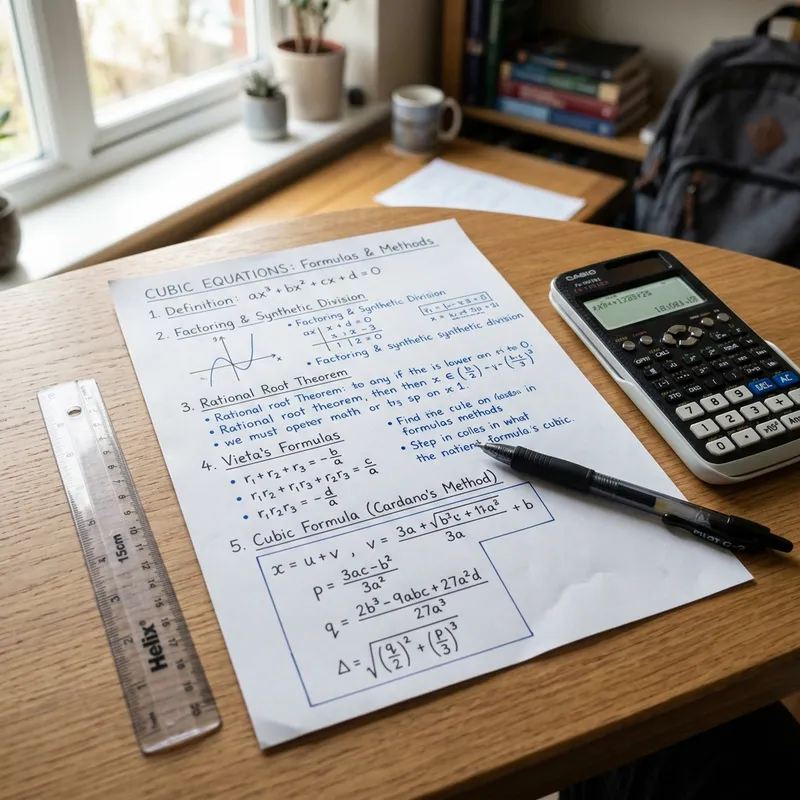
In higher-level mathematics, memorization is not the goal—understanding is the goal. However, having a single, centralized reference page where every rule, theorem, formula, and algorithm is instantly accessible can save you hours of frustration.
What this cheat sheet includes: This guide is the ultimate repository for cubic equations. It contains every algebraic formula (like Cardano’s Method and Vieta’s Formulas), every diagnostic test (like the Discriminant and Descartes’ Rule of Signs), and every solving algorithm (like Synthetic Division and Newton-Raphson).
Who should use it:- Students: For completing difficult homework assignments and studying for final exams.
- Teachers: As a comprehensive curriculum guide and printable resource for the classroom.
- Engineers: For rapid reference when calculating physical stress limits or signal frequencies.
- Competitive exam candidates: For memorizing the algebraic shortcuts required to pass the AMC, SAT, or university entrance exams.
- Researchers: As a centralized hub for advanced algebraic identities.
When to use this guide: Bookmark this page. Do not attempt to read it like a novel. Instead, use the table of contents to instantly jump to the specific formula or table you need while actively solving problems.
Standard Form of a Cubic Equation
Before applying any formula, the equation must be perfectly organized.
The Formula:
Understanding the components:- : The leading coefficient. It determines the steepness and direction of the graph. It cannot equal zero ().
- : The quadratic coefficient.
- : The linear coefficient.
- : The constant term. This is always the y-intercept of the graph.
- Degree: The highest exponent. For a cubic, the degree is exactly 3.
- Variable: The unknown letter (usually ) that represents the roots we are trying to find.
Example: In the equation :
Special Forms of Cubic Equations
Cubic equations do not always look like the standard form. Recognizing these special cases unlocks massive algebraic shortcuts.
| Form Name | Algebraic Structure | Explanation | Example |
|---|---|---|---|
| Complete Cubic | All four terms are present. The most difficult to solve. | ||
| Monic Cubic | The leading coefficient is exactly . Easier to use the Rational Root Theorem. | ||
| Depressed Cubic | The term is missing (). Mandatory for using Cardano’s Method. | ||
| Incomplete Cubic | Missing the and terms. Solved instantly by cube-rooting. | ||
| Factorized Form | Broken into three linear pieces. The roots are instantly visible. |
Factoring Formulas
If a cubic equation matches a specific algebraic pattern, you can factor it instantly without doing any division.
1. Common Factor (GCF)
If every term has an , pull it out instantly.
- Formula:
- Example: .
2. Difference of Cubes
Used when subtracting two perfect cubes.
- Formula:
- Example: .
3. Sum of Cubes
Used when adding two perfect cubes.
- Formula:
- Example: .
4. Grouped Factorization
Used when the ratio of the first two terms matches the ratio of the last two.
- Formula:
- Example: .
Cardano’s Method Formula
This is the ultimate, brute-force algebraic formula that solves 100% of cubic equations.
Prerequisite: The equation MUST be a depressed cubic: . (If your equation is , you must first substitute to depress it).
The Complete Formula:
Understanding the variables:- : The coefficient of the term.
- : The constant term.
- The formula yields one real root. To find the other two, you must use polynomial long division and the quadratic formula.
Example: For (): .
Rational Root Theorem Formula
This theorem creates a specific, limited list of fractions that are the only possible clean numerical roots of a polynomial.
The Theorem: If a polynomial has integer coefficients, every rational root MUST be of the form:
Understanding the variables:- : All integer factors of the constant term ().
- : All integer factors of the leading coefficient ().
Example: For : Factors of (-3): Factors of (2): Candidate Roots (): . (Test these candidates using the Factor Theorem).
Factor Theorem Formula
The ultimate algebraic shortcut to verify if an expression perfectly divides a polynomial.
The Formula: A polynomial has a factor if and only if .
Relationship with factors: If you plug a number into an equation and the arithmetic equals exactly zero, you have proven that is a root, and that is a factor.
Example: Is a factor of ? Evaluate : . Because , yes, is a perfect factor!
Remainder Theorem Formula
The parent formula to the Factor Theorem. It finds the mathematical remainder of a division problem without actually doing any division.
The Formula: If a polynomial is divided by , the remainder is exactly equal to .
Polynomial evaluation: Simply flip the sign of the number in your divisor and plug it into the variables. The final calculated number is the remainder.
Example: What is the remainder when is divided by ? Evaluate : . The remainder is exactly 32.
Synthetic Division Cheat Sheet
A lightning-fast, visual algorithm for dividing polynomials by a linear factor .
Workflow Summary:
- Write the value outside a bracket.
- Write the coefficients of the polynomial in a row. (Use 0 for missing terms!).
- Bring down the first coefficient.
- Multiply the bottom number by . Write the result under the next coefficient.
- Add the column straight down.
- Repeat until finished. The final bottom number is the Remainder.
Visual Example:
Divide by . ().
2 |  2   -5    3   -4
  |       4   -2    2
  -------------------
     2   -1    1 | -2
Result: with a remainder of .
Polynomial Long Division Cheat Sheet
The traditional, bulletproof method for dividing polynomials. Required when dividing by quadratics like .
Workflow Summary:
- Divide the first term of the dividend by the first term of the divisor. Write the result on top.
- Multiply that top result by the entire divisor. Write it underneath the dividend.
- Subtract the entire row. (Flip the signs!).
- Bring down the next term.
- Repeat until you can no longer divide. The leftover piece is the remainder.
Example:
Divide by .
- . (Top).
- .
- Subtract: .
- Bring down .
- . (Top).
- .
- Subtract: .
Result: with a remainder of 0.
Vieta’s Formulas
These formulas prove that the roots () of a cubic equation are perfectly tied to the coefficients () of that equation.
| Formula Name | Algebraic Relationship | Output |
|---|---|---|
| Sum of Roots | ||
| Pairwise Products | ||
| Product of Roots |
Worked Example: For : Sum of roots: . Pairwise products: . Product of roots: .
Descartes’ Rule of Signs
A diagnostic tool that predicts the maximum number of positive and negative real roots by counting algebraic sign flips.
The Rules:
- Positive Roots: Count the number of sign flips ( to or to ) in . The maximum number of positive roots is that number, minus any even integer (2, 4…).
- Negative Roots: Create by flipping the signs of all odd exponents. Count the sign flips. The maximum number of negative roots is that number, minus any even integer.
Example: . Signs: . Flips: 2. Positive roots: 2 or 0. . Signs: . Flips: 1. Negative roots: Exactly 1.
Discriminant Formula
The ultimate diagnostic formula that tells you whether your roots are real, complex, or repeated.
The Complete Cubic Discriminant ():
Interpretation Table
| Discriminant Value | Geometric Meaning | Nature of Roots |
|---|---|---|
| Positive () | The graph crosses the x-axis 3 separate times. | 3 distinct real roots. |
| Negative () | The graph crosses the x-axis 1 time. | 1 real root, 2 complex roots. |
| Zero () | The graph touches and bounces off the x-axis. | Repeated roots (Double or Triple). |
Nature of Roots Table
A quick reference guide linking roots, graphical intercepts, and the Discriminant.
| Root Classification | Number of X-Intercepts | Discriminant Requirement |
|---|---|---|
| Three Distinct Real Roots | 3 Intercepts | |
| One Real Root, Two Complex Roots | 1 Intercept | |
| Double Root (and 1 single root) | 2 Intercepts (1 cross, 1 bounce) | |
| Triple Root | 1 Intercept (Flattens horizontally) | (and ) |
Multiplicity Cheat Sheet
Multiplicity counts how many times the exact same numerical root appears in the factored equation.
- Multiplicity 1 (Single Root): Factor looks like . The graph slices cleanly and directly through the x-axis.
- Multiplicity 2 (Double Root): Factor looks like . The graph approaches the x-axis, touches it perfectly, and bounces back in the direction it came from.
- Multiplicity 3 (Triple Root): Factor looks like . The graph hits the x-axis, perfectly flattens out horizontally, and then continues crossing.
Example: In . crosses cleanly. bounces. flattens and crosses.
Newton-Raphson Formula
A Calculus-based approximation algorithm used by computers to find messy, irrational decimal roots.
The Iteration Formula:
Algorithm Summary:- Guess a starting number ().
- Plug into the original function .
- Plug into the first derivative of the function .
- Use the formula above to calculate the next guess ().
- Repeat the process using to find .
- Stopping criteria: Stop when your answers stop changing (e.g., and both equal ).
Example: Find root for . (Derivative ). Guess . .
Cubic Graph Cheat Sheet
How to instantly sketch or interpret a cubic graph just by looking at the standard equation.
- End Behavior (Positive ): The graph starts in the bottom-left corner () and ends in the top-right corner ().
- End Behavior (Negative ): The graph starts in the top-left corner () and ends in the bottom-right corner ().
- Y-Intercept: Exactly equal to the constant term . Coordinate is .
- Turning Points: A cubic graph can have a maximum of 2 turning points (one peak, one valley). It can also have 0 turning points. It can never have exactly 1.
- Inflection Point: Every cubic graph has exactly 1 inflection point (where the curve changes from a bowl shape to a dome shape). Found at .
Solving Workflow
Follow this precise decision tree to solve any cubic equation efficiently.
- Can it be factored? Check for a Greatest Common Factor (), or group factoring. If yes, factor it and solve the quadratic. If no, move to step 2.
- Use Rational Root Theorem: Generate candidates.
- Use the Factor Theorem: Plug the candidates into until one equals exactly 0. You have found your first root.
- Use Synthetic Division: Divide the cubic equation by that root to reduce it to a quadratic equation.
- Solve the Quadratic: Use factoring or the Quadratic Formula on the remaining piece to find the last two roots.
- (Emergency) Use Cardano’s Method: If the Rational Root Theorem fails (the roots are irrational or complex), depress the cubic and use Cardano’s brute-force formula.
- Verify roots: Multiply the three roots together. They must equal (Vieta’s Formula).
Common Algebra Identities
These advanced factoring identities frequently appear in cubic math competitions and engineering problems.
- Difference of Squares:
- Perfect Square (Plus):
- Perfect Square (Minus):
- Perfect Cube (Plus):
- Perfect Cube (Minus):
- Sum of Squares of Roots:
Calculator Shortcuts
How to use a graphing calculator (TI-84, Desmos) to bypass algebraic legwork.
- Checking roots: Use the
Tablefunction. Enter your polynomial into . Scroll down the table until equals 0. The value is your root. - Verifying factors: Graph the polynomial. If you think is a factor, look at the graph at . If it crosses the axis, you are correct.
- Avoiding mistakes: Never type
-2^2into a calculator. It will output-4. Always use parentheses for negative numbers:(-2)^2 = 4. - Estimating graphs: Use
ZEROorROOTcalculation functions in the graph menu to find irrational decimals to 6 decimal places.
Common Mistakes
Avoid these fatal errors when using the formulas on this cheat sheet.
- Wrong signs: When using the Factor Theorem for , students plug in instead of positive .
- Missing coefficients: Running Synthetic Division on and forgetting to write the zero placeholders (
1 0 0 -8). - Arithmetic mistakes: Dropping a single negative sign when calculating the massive Discriminant () formula, changing the entire classification from 3 real roots to 1 real root.
- Ignoring multiplicity: Writing down that the equation has “only one root.” A cubic ALWAYS has three roots. They are .
- Misreading Descartes’ Rule: Counting 4 sign changes and saying “It has exactly 4 positive roots.” It has 4, or 2, or 0.
Practice Section
Test your memory of the cheat sheet.
Quick Formula Questions
- What is the standard form of a cubic equation?
- What formula factors ?
- What is the Sum of Roots formula?
- What is the Product of Roots formula?
- How do you find candidates using the Rational Root Theorem?
- If , what does the Factor Theorem guarantee?
- If , what does the Remainder Theorem guarantee?
- What does mean for a cubic equation?
- How many turning points can a cubic graph have?
- What does an even multiplicity (e.g., ) do to a graph?
- What exponents do you flip when executing Descartes’ Rule for negative roots?
- What does a “depressed” cubic equation look like?
- What is the -intercept of ?
- What algebraic form allows you to instantly see the roots?
- What is the final stopping criteria for the Newton-Raphson method?
Quick Answers
- .
- .
- .
- .
- Factors of the constant () divided by factors of the leading coefficient ().
- That is a perfect factor of the polynomial.
- That dividing by leaves a remainder of exactly 7.
- The equation has 1 real root and 2 complex imaginary roots.
- Either exactly 2, or exactly 0.
- It causes the curve to touch the x-axis and “bounce” back.
- All the odd exponents ().
- (The term is missing).
- The coordinate .
- Factorized form: .
- When the calculated decimal answers stop changing between iterations.
Frequently Asked Questions
What is the cubic equation formula?
The standard form is . The formula to solve it universally is known as Cardano’s Method.
How do you solve cubic equations?
Ideally, by using the Rational Root Theorem to guess a root, Synthetic Division to divide it, and the Quadratic formula to finish it.
What is Cardano's formula?
A massive algebraic formula utilizing cube roots and square roots that can solve any depressed cubic equation.
What is the discriminant formula?
. It determines if roots are real, complex, or repeated.
What are Vieta's formulas?
Three rules connecting roots to coefficients: Sum (), Pairwise sum (), and Product ().
How do you factor cubic equations?
Using group factoring, the sum/difference of cubes formulas, or by pulling out a Greatest Common Factor (GCF).
What formulas should I memorize?
Memorize the Rational Root Theorem, Synthetic Division workflow, and the Factor Theorem. They are used in 95% of problems.
What is the fastest solving method?
Graphing calculators are the absolute fastest. By hand, the Rational Root Theorem paired with Synthetic Division is fastest.
Can calculators solve cubic equations?
Yes, most advanced graphing calculators have a PolySmlt or Equation Solver app that calculates all 3 roots instantly.
Which formula should I use first?
Always start with Descartes’ Rule of Signs to see if the roots will be positive or negative. Then use the Rational Root Theorem.
Is there a simple formula like the Quadratic Formula?
No. Cardano’s formula is the equivalent, but it is extraordinarily long and requires complex number arithmetic.
What does a "monic" cubic mean?
It means the leading coefficient () is exactly . (e.g., ).
What is a "depressed" cubic?
It is a cubic missing its quadratic term. (e.g., ).
Do I need Calculus for cubic equations?
No, algebra is sufficient for 99% of problems. However, Calculus (Newton-Raphson) is used to program computers to estimate irrational roots.
How many roots does a cubic have?
Exactly 3. (They can be real, complex, or repeated, but they always add up to 3).
Why do I get an 'i' in my answer?
Because the equation only crossed the x-axis once. The remaining two roots are complex imaginary numbers.
What is an inflection point?
The exact center of the cubic graph where the curve changes from facing up (like a bowl) to facing down (like a dome).
What is multiplicity?
It is the count of how many times a single root repeats. Multiplicity 2 creates a “bounce” on the graph.
What is the Remainder Theorem?
A rule stating that equals the exact mathematical remainder of dividing the polynomial by .
How is the Factor Theorem different?
The Factor Theorem is just the Remainder Theorem when the answer happens to be exactly 0.
Why are complex roots always in pairs?
Because polynomials have real coefficients. To cancel out the imaginary parts, the roots must exist as positive and negative conjugates ( and ).
Can a cubic equation have NO real roots?
No. Because complex roots travel in pairs, a cubic (which has 3 roots) MUST have at least one real root.
Does Synthetic Division work for x^2?
No, standard Synthetic Division only works when dividing by linear expressions like .
How do you find the y-intercept?
Look at the standard form. The coefficient is the exact y-intercept coordinate .
Why is Cardano's Method not taught in high school?
Because it frequently encounters the Casus Irreducibilis, forcing students to do trigonometry and imaginary number arithmetic to find normal integers.
How do I memorize Vieta's signs?
They always alternate: Negative, Positive, Negative. ().
What is the sum of cubes formula?
. Notice the signs are SOAP (Same, Opposite, Always Positive).
How many turning points does y=x^3 have?
Zero. It perfectly flattens out at the origin and continues upward without ever peaking or dipping.
What does it mean to "verify" roots?
After finding your 3 answers, multiply them all together. If they do not equal , your answers are wrong.
Can I print this cheat sheet?
Yes! We recommend printing this guide or bookmarking it on your phone to use as a master reference while doing homework.
Summary
This Cubic Equation Formula Cheat Sheet is your master key to navigating polynomial mathematics.
You do not need to memorize every single letter of the massive cubic Discriminant or Cardano’s method. The goal is to understand the architecture of cubic equations. If you know that Vieta’s formulas link roots to coefficients, that the Factor Theorem bypasses long division, and that the Rational Root Theorem provides the candidates, you can solve any algebraic problem thrown your way.
Bookmark this page and use it as your daily reference guide. Whenever you encounter a polynomial that seems unsolvable, consult the Decision Tree workflow above to find the exact algebraic tool required to break it apart.
Continue your mathematical journey with our related, in-depth guides:
- What Is a Cubic Equation? Fundamentals
- How to Solve Cubic Equations Step-by-Step
- How to Factor Cubic Equations: 9 Methods
- How to Use the Rational Root Theorem
- Synthetic Division: The Ultimate Shortcut
- Polynomial Long Division Explained
- Understanding the Factor and Remainder Theorems
- Vieta’s Formulas for Cubic Equations
- Descartes’ Rule of Signs
- How to Solve Cubic Equations Using Cardano’s Method
- Newton-Raphson Method for Polynomials