
Education
Cubic vs Quadratic Equations: Complete Comparison Guide
Discover the exact differences between cubic and quadratic equations. Compare formulas, graphs, roots, and real-world applications with 30 practice problems.
By Mathematics Educator | 6/30/2026
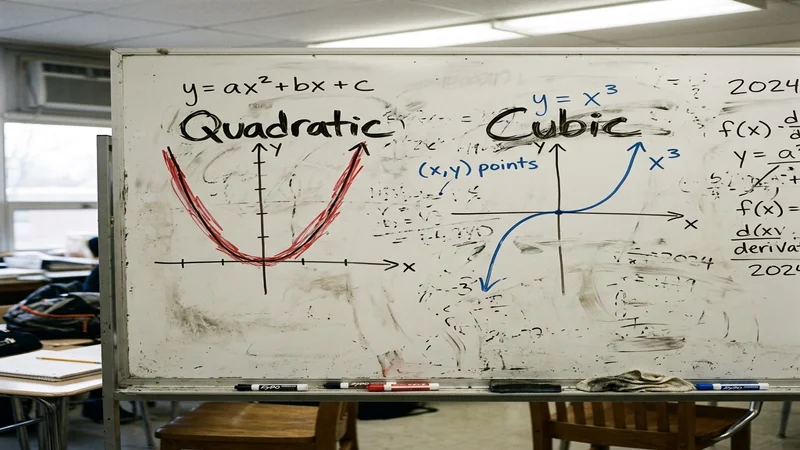
Polynomial equations form the bedrock of algebra, guiding everything from high school math curriculum to advanced engineering simulations. While polynomials can technically have infinitely high degrees, quadratic (degree 2) and cubic (degree 3) equations are by far the most commonly studied and frequently applied in the real world.
Why are they so prevalent? Because quadratic equations perfectly model two-dimensional forces like gravity and area optimization, while cubic equations govern three-dimensional volume, dynamic curves, and complex economics.
Whether you are a student transitioning from basic algebra to pre-calculus, a teacher looking for a definitive side-by-side comparison, or a professional needing a refresher on mathematical modeling, this guide is for you.
By the end of this comprehensive article, you will understand exactly how these two powerhouse equations differ in terms of algebraic structure, graphical behavior, root calculation, and real-world utility. We have packed this guide with detailed comparison tables, 10 fully worked examples, and 30 practice problems to test your mastery.
Section 1. What Is a Quadratic Equation?
A quadratic equation is the mathematical gateway into non-linear algebra. It is the first equation students encounter where the graph is not just a straight line.
General Form
The standard algebraic representation of a quadratic equation is: ax² + bx + c = 0 (where a, b, and c are known numbers, and a ≠ 0)
Degree and Coefficients
- Degree: A quadratic is a polynomial of degree 2, meaning the highest exponent attached to the variable x is exactly 2.
-
Coefficients:
- The leading coefficient (a) determines how wide or narrow the graph is, and whether it points up or down.
- The linear coefficient (b) dictates the symmetry and position of the peak.
- The constant (c) represents the y-intercept.
Roots
Because the degree is 2, the Fundamental Theorem of Algebra states that a quadratic equation will always have exactly two roots. However, these two roots can take three different forms: two distinct real numbers, one repeated real number, or a pair of complex conjugate numbers (imaginary numbers).
Graph and Vertex
The graph of a quadratic equation is called a parabola. It is a perfectly symmetrical “U” or upside-down “U” shape. The most critical point on this graph is the vertex: the absolute highest or lowest point of the curve. The vertical line that perfectly splits the parabola in half through the vertex is known as the axis of symmetry.
Examples
- x² - 9 = 0 (Roots are 3 and -3)
- 2x² + 4x - 6 = 0
- x² + 16 = 0 (Roots are complex: 4i and -4i)
Common Applications
Quadratic equations are heavily used in basic physics. Any time an object is thrown into the air, its trajectory is modeled by a downward-facing parabola. They are also used in basic finance to find the break-even points of simple business models, and in geometry to maximize rectangular areas given a fixed perimeter.
Section 2. What Is a Cubic Equation?
If quadratics represent the 2D world of area and basic gravity, cubic equations represent the 3D world of volume and dynamic fluid change.
General Form
The standard representation of a cubic equation is: ax³ + bx² + cx + d = 0 (where a, b, c, and d are known numbers, and a ≠ 0)
Degree and Coefficients
- Degree: A cubic is a polynomial of degree 3. The presence of the x³ term guarantees a profound shift in mathematical complexity compared to the quadratic.
-
Coefficients:
- a dictates the ultimate direction the ends of the graph will point.
- b and c influence the waviness of the curve.
- d is the y-intercept.
Roots
Because the degree is 3, a cubic equation has exactly three roots. Unlike the quadratic, a cubic equation is mathematically guaranteed to have at least one real root. The other two can be real, repeated, or a complex conjugate pair.
Turning Points and Inflection Point
While a quadratic graph only has one turning point (the vertex), a cubic graph can have up to two turning points (a local maximum and a local minimum). More importantly, every cubic graph features exactly one inflection point: the precise moment where the curve stops bending one way (e.g., concave down) and starts bending the other way (e.g., concave up).
Examples
- x³ - 27 = 0 (One real root: 3, plus two complex roots)
- x³ - 6x² + 11x - 6 = 0 (Three real roots: 1, 2, and 3)
- 2x³ + 4x² - x = 0
Applications
Cubic polynomials are used in advanced structural engineering (calculating beam deflection), aerodynamics, 3D computer graphics (Bezier curves), and thermodynamics (modeling the volume of real gases).
Section 3. Cubic vs Quadratic at a Glance
For a rapid understanding of how these equations compare, review this detailed comparison table.
| Feature | Quadratic Equations | Cubic Equations |
|---|---|---|
| Degree | 2 | 3 |
| General Form | ax² + bx + c = 0 | ax³ + bx² + cx + d = 0 |
| Maximum Number of Roots | 2 | 3 |
| Minimum Real Roots | 0 (Can be all complex) | 1 (Guaranteed by odd degree) |
| Real Root Possibilities | 0, 1 (repeated), or 2 | 1, 2 (one repeated), or 3 |
| Complex Root Possibilities | 2 | 2 (They always come in pairs) |
| Graph Shape | Parabola (U-shape) | S-curve (Wavy line) |
| Turning Points | Exactly 1 (The vertex) | 0 or 2 |
| Inflection Point | None | Exactly 1 |
| Symmetry | Line symmetry (Axis of symmetry) | Point symmetry (Around the inflection point) |
| Solving Methods | Factoring, Quadratic Formula | Factoring, Synthetic Division, Cardano’s Method |
| Difficulty to Solve | Easy (Formula is easily memorized) | Hard (Formula is highly complex) |
| Applications | Projectile motion, area optimization | 3D graphics, fluid dynamics, volume modeling |
| Computational Complexity | Low (Basic arithmetic) | High (Requires cube roots of complex numbers) |
Section 4. Key Differences Between Cubic and Quadratic Equations
Let’s break down the mathematical differences highlighted in the table above into detailed explanations.
Highest Exponent (Degree)
The most defining difference is the degree. A quadratic is governed by x², making it an “even degree” polynomial. A cubic is governed by x³, making it an “odd degree” polynomial. This single integer difference fundamentally changes the geometry of the functions.
Number of Solutions
The Fundamental Theorem of Algebra dictates that the highest exponent equals the total number of solutions (including complex and repeated roots). Therefore, quadratics yield a maximum of two solutions, while cubics yield three.
Shape of Graphs and End Behavior
Because the quadratic is an even degree, the ends of its graph must both point in the same direction (both up to +∞, or both down to -∞). It creates a “U” shape. Because the cubic is an odd degree, the ends of its graph must point in opposite directions (one up to +∞, and one down to -∞). This ensures the graph must cross the x-axis at least once, creating its signature “S” shape.
Symmetry
Quadratics possess line symmetry. If you fold a parabola in half along its vertical axis, both sides match perfectly. Cubics possess point symmetry. You cannot fold them in half, but if you rotate the graph 180 degrees around its central inflection point, it looks identical.
Turning Points and Inflection Points
A turning point is where the graph changes from going up to going down. A quadratic has exactly 1 turning point (the vertex). A cubic can have 2 turning points (a peak and a valley), or it can have zero turning points if it just flattens out briefly and continues in the same direction. Conversely, quadratics have 0 inflection points, while cubics always have exactly 1.
Complexity of Calculations
Quadratic equations can be solved by high school freshmen using the Quadratic Formula. Cubic equations, when unfactorable, require Cardano’s Method: a multi-step algebraic process that requires finding the cube root of imaginary numbers. For this reason, modern professionals almost exclusively use digital calculators to solve cubics.
Section 5. Graph Comparison
The visual differences between these two polynomials are striking.
Quadratic Graphs (The Parabola)
When you plot y = ax² + bx + c, the resulting curve is a parabola.
- Vertex: The most important coordinate on this graph is the vertex, calculated by the formula x = -b / (2a). This is the absolute maximum or minimum of the data set.
- Interpretation: In business, the vertex represents the point of maximum profit. In physics, it represents the highest altitude of a launched rocket.
Cubic Graphs (The S-Curve)
When you plot y = ax³ + bx² + cx + d, the resulting curve flows from one end of the y-axis to the other.
- Inflection Point: The defining characteristic of a cubic graph is its inflection point. This is the coordinate where the “bend” of the curve reverses.
- Graph Interpretation: While quadratics find an absolute maximum, cubics find “local” maximums and minimums. In economics, a cubic curve perfectly models how costs rise, briefly level off due to economies of scale (the inflection point), and then rise sharply again.
Section 6. Comparing Roots
Understanding the roots (x-intercepts) is the primary goal of solving these equations.
Quadratic Roots
A quadratic equation can cross the x-axis up to two times.
- Two Real Roots: The parabola crosses the x-axis twice.
- One Repeated Root: The vertex of the parabola sits perfectly on the x-axis, just touching it.
- Complex Roots (Zero Real Roots): The entire parabola floats above or below the x-axis, never crossing it. The solutions exist entirely in the complex plane.
Cubic Roots
A cubic equation must cross the x-axis at least once because its ends stretch to positive and negative infinity.
- Three Real Roots: The curve aggressively waves, crossing the x-axis, dipping down, crossing again, peaking, and crossing a third time.
- One Real Root and Two Complex Roots: The curve crosses the x-axis once, then turns around but doesn’t have enough length to cross it again. The missing two intercepts are complex conjugates.
- Repeated Roots: The curve might cross the axis once, and then be perfectly tangent to the axis at a second point (a root of multiplicity 2).
Section 7. Solving Methods
Because of their differing degrees, the tools required to solve these equations scale dramatically in difficulty.
Solving Quadratic Equations
- Factoring: The fastest method if the roots are clean integers.
- Completing the Square: A reliable geometric method for rearranging the formula.
- The Quadratic Formula: The ultimate fallback that works for every single quadratic equation in existence.
genui{“algebra_functions_learning_block”:{“type_id”:“QUADRATIC_FORMULA”}}
Solving Cubic Equations
- Factoring by Grouping: Only works on very specific cubics where the ratio of coefficients matches.
- Rational Root Theorem: Used to guess and check for rational roots, allowing you to use synthetic division to reduce the cubic to a quadratic.
- Cardano’s Method: The cubic equivalent to the quadratic formula. It requires “depressing” the cubic (removing the x² term) and executing massive algebraic substitutions.
- Online Calculators: Because Cardano’s method is incredibly tedious and prone to arithmetic errors, most engineers use software like our Cubic Equation Solver to get instant, accurate roots.
Section 8. Worked Examples
Let’s look at how the math plays out in reality.
Example 1: Simple Factored Quadratic
Equation: x² - 7x + 10 = 0
Step 1: Find two numbers that multiply to 10 and add to -7. (Those are -5 and -2).
Step 2: Factor: (x - 5)(x - 2) = 0.
Result: Roots are x = 5 and x = 2.
Example 2: Quadratic Formula
Equation: 2x² - 4x - 3 = 0
Step 1: Identify a=2, b=-4, c=-3.
Step 2: Apply quadratic formula: x = [4 ± √(16 - 4(2)(-3))] / 4.
Step 3: Simplify: x = [4 ± √(40)] / 4 = [4 ± 2√10] / 4.
Result: Roots are x = 1 + 0.5√10 and x = 1 - 0.5√10.
Example 3: Quadratic with Complex Roots
Equation: x² + 25 = 0
Step 1: Isolate x²: x² = -25.
Step 2: Take the square root: x = ±√(-25)
Result: Roots are x = 5i and x = -5i.
Example 4: Simple Factored Cubic
Equation: x³ - 4x = 0
Step 1: Factor out x: x(x² - 4) = 0.
Step 2: Factor the difference of squares: x(x - 2)(x + 2) = 0.
Result: Three real roots: x = 0, x = 2, x = -2.
Example 5: Cubic Factoring by Grouping
Equation: x³ - 3x² - 4x + 12 = 0
Step 1: Group terms: x²(x - 3) - 4(x - 3) = 0.
Step 2: Factor out common binomial: (x - 3)(x² - 4) = 0.
Step 3: Expand: (x - 3)(x - 2)(x + 2) = 0.
Result: Roots are x = 3, 2, -2.
Example 6: Cubic with One Real Root (Difference of Cubes)
Equation: x³ - 8 = 0
Step 1: Expand: (x - 2)(x² + 2x + 4) = 0.
Step 2: The real root is x = 2.
Step 3: Use quadratic formula on x² + 2x + 4 to find complex roots.
Result: x = 2, x = -1 + i√3, x = -1 - i√3.
Example 7: Cubic by Synthetic Division
Equation: x³ - 6x² + 11x - 6 = 0
Step 1: Test x=1 (1 - 6 + 11 - 6 = 0). It is a root!
Step 2: Divide the cubic by (x - 1) using synthetic division. The result is x² - 5x + 6 = 0.
Step 3: Factor the quadratic: (x - 2)(x - 3) = 0.
Result: Roots are x = 1, 2, 3.
Example 8: Quadratic Optimization (Real World)
Problem: A farmer has 100 feet of fence to build a rectangular pen against a river (no fence on the river side). Maximize the area.
Equation: Area = x(100 - 2x) = -2x² + 100x.
Step 1: Find the vertex x = -b/(2a) = -100 / (2 * -2) = 25.
Result: The optimal width is 25 feet.
Example 9: Cubic Volume (Real World)
Problem: Find the maximum volume of a box made from a 12x12 cardboard sheet by cutting x-sized squares from the corners.
Equation: V = x(12 - 2x)² = 4x³ - 48x² + 144x.
Step 1: To maximize, take derivative (12x² - 96x + 144) and set to 0.
Step 2: Divide by 12: x² - 8x + 12 = 0. Factor: (x - 6)(x - 2) = 0.
Result: A cut of x=2 yields the maximum volume. (x=6 yields a volume of 0).
Example 10: Repeated Cubic Root
Equation: x³ - 3x² + 3x - 1 = 0
Step 1: Recognize the binomial cube expansion: (x - 1)³ = 0.
Result: Root is x = 1 with a multiplicity of 3.
Section 9. Real World Applications
Mathematical equations are just tools to model reality. Here is when professionals choose one tool over the other.
When to Use Quadratic Equations
- Projectile Motion: Any object in freefall or flying through the air (baseballs, artillery shells, rockets) follows a parabolic path perfectly modeled by a quadratic equation.
- Area Optimization: Calculating the maximum square footage of land within a constrained perimeter always yields a quadratic model.
- Parabolic Reflectors: The mirrors inside car headlights, satellite dishes, and astronomical telescopes use the geometry of a quadratic parabola to focus light and radio waves perfectly to a single point.
- Economics: Basic profit maximization (Revenue - Cost) is often modeled as a downward-facing parabola to find the peak earning point.
When to Use Cubic Equations
- Structural Engineering: Calculating how far a steel beam will sag (deflection) under the weight of a skyscraper floor relies on cubic polynomial curves.
- Fluid Dynamics: Modeling the velocity of thick liquids flowing through cylindrical pipes uses cubic profiles.
- Computer Graphics: Adobe Illustrator and modern video games use “Cubic Bezier Curves” to draw smooth, flowing 3D shapes without pixelated, jagged edges.
- Robotics: When programming a robotic arm to move smoothly from a dead stop, accelerate, and decelerate to another dead stop, engineers use a cubic trajectory to ensure the machine doesn’t violently jerk.
The Verdict: If the problem involves constant acceleration, gravity, or 2D area, use a quadratic. If the problem involves changing acceleration, 3D volume, or smooth physical curves, use a cubic.
Section 10. Advantages and Limitations
Quadratic Equations
| Advantages | Limitations |
|---|---|
| Very easy to calculate by hand. | Cannot model complex 3D shapes. |
| The Quadratic Formula is universally memorized. | Cannot model systems that change direction twice (S-curves). |
| Extremely accurate for basic physics and gravity. | Inadequate for aerodynamics and fluid dynamics. |
Cubic Equations
| Advantages | Limitations |
|---|---|
| Perfect for modeling 3D physical volume. | Incredibly tedious to solve manually via Cardano’s Method. |
| Can model complex economic and data trends (S-curves). | Generates complex imaginary roots that confuse beginners. |
| Essential for modern computer graphics (splines). | Overkill for simple 2D geometry problems. |
Section 11. Common Mistakes
When transitioning from quadratics to cubics, students frequently make these errors:
- Confusing Degree with Number of Roots: Assuming a quadratic has 2 roots and a cubic has 3 roots is generally true, but forgetting about repeated roots and complex roots leads to miscounting the physical intercepts on a graph.
- Assuming Every Cubic Has 3 Real Roots: While a cubic has 3 mathematical roots, it often only crosses the x-axis once, hiding two complex conjugate roots in the imaginary plane.
- Misinterpreting Graph Behavior: Assuming the “valley” of a cubic graph represents the absolute minimum of the function. Cubics stretch to negative infinity; the valley is only a local minimum.
- Using the Quadratic Formula on Cubics: You cannot plug cubic coefficients (a, b, c, d) into the quadratic formula. It will yield complete nonsense.
- Ignoring the Discriminant Rules: The discriminant for a quadratic (b² - 4ac) behaves differently than the discriminant for a cubic. A negative quadratic discriminant means zero real roots. A negative cubic discriminant means exactly one real root.
Section 12. Practice Problems
Test your knowledge on the differences between these polynomials.
10 Beginner Questions (Identification and Theory)
- What is the degree of a quadratic equation?
- How many total roots does a cubic equation have?
- Which graph forms a parabola?
- What is the maximum number of times a quadratic graph can cross the x-axis?
- Does a cubic graph always cross the x-axis at least once?
- Which equation uses the formula x = [-b ± √(b² - 4ac)] / 2a?
- What is the turning point of a parabola called?
- Does a quadratic graph have an inflection point?
- True or False: A cubic equation can have exactly two complex roots.
- Which equation would you use to find the maximum area of a rectangle?
10 Intermediate Questions (Graphing and Roots)
- If a quadratic discriminant is negative, how many real roots exist?
- If a cubic crosses the x-axis exactly one time, what kind of roots make up the other two solutions?
- Describe the end behavior of the cubic graph y = 2x³.
- Describe the end behavior of the quadratic graph y = -5x².
- Factor the quadratic x² - 16 = 0.
- Factor the cubic x³ - 16x = 0.
- How many turning points does the graph of y = x³ - x have?
- If a quadratic has a root at x = 2 + 3i, what is its other root?
- Can a cubic equation have roots at x = 1, x = 2, and x = 5i? Why or why not?
- What is the axis of symmetry for y = 2x² - 8x + 3?
10 Advanced Questions (Application and Calculation)
- A cubic equation has roots at 0, 2, and -2. Write the expanded equation.
- Solve x³ - 8 = 0 for all three roots (including complex).
- Use the discriminant to determine the nature of the roots for 3x² - 4x + 5 = 0.
- A box with an open top is formed from a 20x20 sheet by cutting x-sized squares from the corners. Write the cubic volume equation.
- Explain the mathematical difference between the vertex of a parabola and the inflection point of a cubic.
- Use synthetic division to show that x = 2 is a root of x³ - 4x² + x + 6 = 0, and find the other roots.
- Why is Cardano’s method rarely taught in high school compared to the quadratic formula?
- A projectile’s height is h(t) = -16t² + 64t. At what time t does it hit the ground?
- A company’s cost curve is C(q) = q³ - 3q² + 5q. What degree polynomial is their Marginal Cost curve (the derivative)?
- Prove that a cubic equation cannot have three complex roots.
The Questions
Frequently Asked Questions
What is the difference between cubic and quadratic equations? +
The primary difference is the highest exponent. A quadratic has a highest exponent of 2 (degree 2) and forms a parabolic graph. A cubic has a highest exponent of 3 (degree 3) and forms an S-shaped wavy graph.
Which is harder, cubic or quadratic equations? +
Cubic equations are significantly harder. Quadratics can be solved easily using the quadratic formula. Solving a cubic by hand often requires Cardano's method, which involves grueling substitutions and complex numbers.
Can quadratic equations have three roots? +
No. By the Fundamental Theorem of Algebra, a degree-2 polynomial can only have exactly two roots (including complex and repeated roots).
Can cubic equations have two roots? +
No. A cubic equation always has exactly three mathematical roots. However, it can have a "repeated root" (multiplicity 2), making it look like there are only two unique intercepts on a graph.
Why do cubic equations have more complex graphs? +
The x³ term allows the curve to change direction twice (creating peaks and valleys) and ensures the ends of the graph point in opposite directions to positive and negative infinity.
How many turning points can a cubic graph have? +
A cubic graph can have a maximum of two turning points (one local peak and one local valley), or it can have zero turning points if the curve flattens and continues in the same direction.
How many turning points can a quadratic graph have? +
A quadratic graph has exactly one turning point, which is known as the vertex of the parabola.
Can cubic equations be solved using the quadratic formula? +
No. The quadratic formula only works for degree-2 polynomials. However, you can use the quadratic formula to find the final two roots of a cubic *after* you have factored out the first linear root.
What is Cardano's method? +
Cardano's method is the algebraic formula used to find the exact roots of any cubic equation, similar to the quadratic formula but much more complicated.
Which equation is used more in engineering? +
Both are used heavily. Quadratics are used for structural arches and optimizing 2D stress, while cubics are used to calculate 3D structural deflection and trajectory smoothing in robotics.
What are the applications of quadratic equations? +
They are used in physics to calculate gravity and projectile motion, in optics to design parabolic telescope mirrors, and in business to find maximum profit points.
What are the applications of cubic equations? +
They are used to calculate 3D volume, model thermodynamic gas compression, predict economic cost curves, and generate smooth splines in computer graphics.
How many real roots can each equation have? +
A quadratic can have 0, 1, or 2 real roots. A cubic can have 1, 2, or 3 real roots. (A cubic must always have at least one).
Which graph is easier to interpret? +
The quadratic parabola is much easier to interpret, as its vertex clearly points to the absolute maximum or minimum of the physical scenario.
Which equation is easier to solve? +
The quadratic equation is much easier to solve due to simple factoring techniques and the universally applicable quadratic formula.
Does a cubic equation have a vertex? +
No. Instead of a single vertex, a cubic has "local extrema" (turning points) and an "inflection point" where the curvature of the graph reverses.
Are complex roots possible in both? +
Yes. A quadratic can have two complex conjugate roots (meaning zero real roots). A cubic can also have two complex conjugate roots (leaving exactly one real root).
How does the discriminant differ? +
The quadratic discriminant (b² - 4ac) tells you if roots are real or complex. The cubic discriminant requires a much more complex formula involving cubed and squared terms to classify its three roots.
What shape does a cubic graph make? +
It makes a continuous S-curve that extends from the bottom-left to the top-right of a graph (or top-left to bottom-right, if the leading coefficient is negative).
Do calculators handle both types of equations? +
Basic school calculators handle quadratics easily, but often struggle with the complex arithmetic required for cubics. For third-degree polynomials, you should use a dedicated digital tool.
Section 14. Summary
The leap from quadratic to cubic equations represents a profound shift in mathematical power.
- Quadratic equations (degree 2) are the masters of the 2D plane. They form perfectly symmetrical parabolas, yield a maximum of two roots, and effortlessly model gravity, projectile motion, and basic area optimization.
- Cubic equations (degree 3) are the architects of the 3D world. They form dynamic, wavy S-curves with inflection points, yield three roots, and are vital for calculating physical volume, fluid dynamics, and modern computer graphics.
While quadratics can be solved quickly by hand using the quadratic formula, the immense algebraic difficulty of Cardano’s method makes cubics notoriously frustrating for students to calculate manually.
If you are an engineer, student, or professional dealing with third-degree polynomials, don’t waste time struggling with manual substitutions. We highly recommend using our free, perfectly accurate Cubic Equation Solver on this website to instantly compare, graph, and solve any cubic polynomial you encounter.