
Common Mistakes When Solving Cubic Equations (And How to Avoid Them)
Discover the most common mistakes students make when solving cubic equations. Learn how to fix factoring, synthetic division, and Cardano errors instantly.
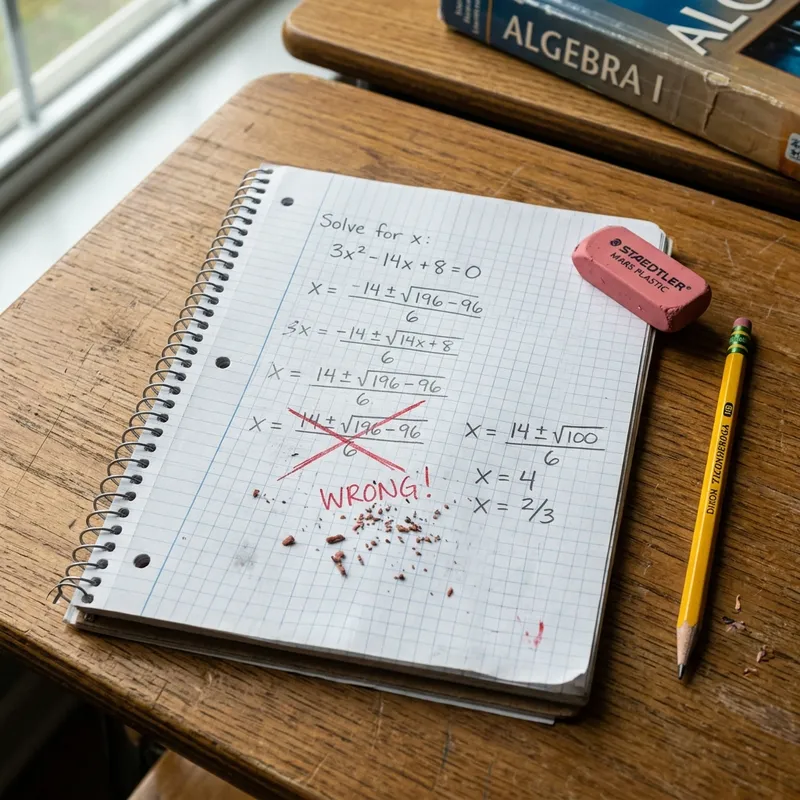
Introduction
Solving a cubic equation () is one of the most rigorous tests a student will face in high school and university algebra. Unlike quadratic equations, which can be solved instantly by plugging numbers into a single memorized formula, cubic equations require an algorithmic approach. You must generate candidates, test them, divide polynomials, and solve remaining fragments.
Why mistakes happen: Because solving a cubic equation is a multi-step process, a single dropped negative sign in step one will cascade, completely destroying steps two, three, and four. Cubic equations heavily punish carelessness.
How this guide helps: This guide is the ultimate troubleshooting manual. It breaks down the 13 most frequent, devastating errors students make. By recognizing these traps before you take your exam, you can save yourself hours of frustration.
Who should read it: Any student who constantly finds themselves asking, “Why is my remainder not zero?” or “Why doesn’t my answer match the textbook?”
Mistake 1. Writing the Equation Incorrectly
The most tragic error in algebra is solving the wrong problem flawlessly.
Missing terms: If the textbook asks you to solve , and you write on your scratch paper, you have fundamentally changed the geometry of the curve.
Wrong coefficients: Transcribing a as an , or a as a .
Incorrect signs: Copying as .
| Incorrect Action | Consequence | Correct Method |
|---|---|---|
| Copying as | The roots will be entirely different, and the Rational Root Theorem will fail. | Place your finger on the textbook and verify every sign before beginning step one. |
Mistake 2. Forgetting to Write the Equation in Standard Form
Explain why standard form is essential: Standard form requires the equation to be written in descending order of exponents () and set perfectly equal to zero. If you do not set the equation to zero, your factors will not equal your roots.
Examples:-
Mistake: Solving by dividing both sides by . (This deletes the root entirely!).
-
Correction: Move to the left: . Now you can factor properly.
-
Mistake: Running synthetic division on .
-
Correction: Reorder the terms first! .
Mistake 3. Choosing the Wrong Solving Method
Many students memorize Cardano’s formula and try to apply it to every problem, wasting 20 minutes on a problem that could have been group-factored in 15 seconds.
Decision Table for Solving Methods
| Equation Type | Best Method | Worst Method |
|---|---|---|
| (Two terms, perfect cubes) | Difference of Cubes formula | Cardano’s Method |
| (Ratios match) | Factoring by Grouping | Rational Root Theorem |
| (Messy, no grouping) | Rational Root + Synthetic Division | Cardano’s Method |
| (Depressed cubic, irrational roots) | Cardano’s Method | Factoring |
The Mistake: Using the Rational Root Theorem to generate 12 candidates when a simple Greatest Common Factor () could have been pulled out immediately.
Mistake 4. Factoring Errors
Factoring is the fastest way to solve, but it is heavily prone to formula memorization errors.
Difference of cubes error:- Formula: .
- Mistake: Students write , confusing it with a perfect square binomial.
- Equation: .
- Mistake: . The student pulled out a but forgot to flip the sign inside the second parenthesis.
- Correction: . Now the blocks match perfectly.
Mistake 5. Rational Root Theorem Errors
The Rational Root Theorem () is the engine that drives cubic solving.
Missing candidates: If the constant term is 12, students often test but completely forget 12.
Ignoring negatives: Testing but forgetting to test . Often, the very first negative candidate is the correct root.
Flipping p and q: The formula is factors of the LAST number () divided by factors of the FIRST number (). Students frequently calculate , resulting in a list of fractions that will never equal zero.
Mistake 6. Synthetic Division Errors
Synthetic division is fast, but a single arithmetic slip destroys the remainder.
Wrong divisor sign:- Problem: Divide by .
- Mistake: Putting on the outside of the synthetic bracket.
- Correction: You must solve . The number to use is positive .
- Problem: Divide by .
- Mistake: Writing the row as
1 -27. - Correction: You MUST represent the missing and terms. The correct row is
1 0 0 -27.
- In Polynomial Long Division, you subtract rows. In Synthetic Division, you ADD rows. Mixing these up guarantees the wrong remainder.
Mistake 7. Polynomial Long Division Errors
Incorrect subtraction (Sign distribution):- Scenario: Subtracting from .
- Mistake: . Then .
- Correction: You must subtract a negative! . ALWAYS put parentheses around what you are subtracting.
- Trying to divide an equation that isn’t in standard descending order will misalign the columns, making like-term addition impossible.
Mistake 8. Cardano’s Method Errors
Cardano’s formula is an absolute monster. Mistakes here are virtually guaranteed without intense focus.
Formula substitution:- Using the formula for when the textbook uses . This flips the sign of every in the formula.
- Scenario: The formula generates .
- Mistake: The student assumes the answer is imaginary and stops.
- Correction: The complex components will actually cancel out with the second half of the formula to produce a real, whole integer root.
Mistake 9. Misinterpreting the Discriminant
The Discriminant () tells you the nature of the roots.
The Misunderstanding: In the quadratic formula, a negative discriminant means NO real roots. In cubic equations, a negative discriminant means exactly ONE real root (and two complex roots). Students see , write “No solution,” and fail the test. A cubic curve goes from to , meaning it MUST cross the x-axis at least once!
Mistake 10. Confusing Real and Complex Roots
Root classification: If you solve a cubic and find , and the remaining quadratic is , the remaining roots are and .
- Mistake: Writing the final answer as "".
- Correction: A cubic ALWAYS has 3 roots. You must list all of them: .
- Mistake: Seeing a graph cross the x-axis exactly once, and concluding “This equation only has 1 root.”
- Correction: It has 1 real root. The other two roots are complex and cannot be seen on a standard Cartesian coordinate plane.
Mistake 11. Ignoring Multiplicity
Repeated roots: If you factor an equation into .
- Mistake: Writing “The root is 2.”
- Correction: The roots are . Multiplicity is a critical concept in higher mathematics.
- Mistake: Trying to draw a line straight through the x-axis for a root of multiplicity 2.
- Correction: An even multiplicity means the graph touches the axis and “bounces” back.
Mistake 12. Calculator Mistakes
Graphing calculators are powerful, but they only do exactly what you type.
Incorrect exponent handling:- Mistake: Typing
-3^2into a TI-84 to evaluate . The calculator outputs-9. - Correction: The calculator follows PEMDAS. It squared the 3, then made it negative. You MUST use parentheses:
(-3)^2outputs the correct9.
- Mistake: The calculator gives a root of . The student writes and uses synthetic division with . The division fails completely.
- Correction: Recognize repeating decimals as fractions. is . Use the exact fraction for synthetic division.
Mistake 13. Not Checking the Final Answer
Leaving an exam without verifying your roots is mathematical gambling.
Verification Methods:- Substitution (Factor Theorem): Plug your root back into the original variables. If it doesn’t equal 0, your root is wrong.
- Vieta’s Formulas (The Ultimate Check): Add your 3 final roots together. Their sum MUST perfectly equal . If it doesn’t, at least one root is wrong.
- Graphing: Plot the equation on a calculator. If your algebraic root is , but the graph crosses at , your algebra is wrong.
Complete Troubleshooting Guide
Use this decision tree when your answer is marked wrong.
- Did your Synthetic Division have a remainder other than 0?
- Yes Check if you forgot a zero placeholder. Check if you multiplied instead of adding. Check if you flipped the sign of .
- Did your Quadratic Formula yield a messy decimal, but the answer key shows an integer?
- Yes You factored the initial cubic incorrectly. The values you fed into the quadratic formula are wrong.
- Does your graph cross at positive 2, but your algebra says negative 2?
- Yes You confused the root with the factor. The factor is , which means the root is .
- Did you get 1 real root, but the problem asked for 3?
- Yes You forgot to use the quadratic formula on the remaining polynomial to find the imaginary roots.
Worked Examples: Incorrect vs Correct
Let’s look at 20 side-by-side comparisons of catastrophic errors and their perfect corrections.
Factoring Errors
Example 1: Grouping Sign Error Equation:
- INCORRECT: . (Cannot be factored further).
- CORRECT: .
Example 2: Difference of Cubes Middle Term Equation:
- INCORRECT: .
- CORRECT: . (Sign is opposite, term is , not ).
Example 3: Forgetting the GCF Constant Equation:
- INCORRECT: .
- CORRECT: .
Example 4: Canceling the variable Equation:
- INCORRECT: Divide by . Answer: . (You lost a double root!)
- CORRECT: . Answers: .
Theorem Errors
Example 5: Rational Root flip Equation:
- INCORRECT: Candidates are factors of 3 divided by factors of 1: .
- CORRECT: Candidates are factors of 1 divided by factors of 3: .
Example 6: Evaluating negative exponents Evaluate for .
- INCORRECT: .
- CORRECT: .
Example 7: Remainder Theorem Interpretation .
- INCORRECT: is a factor.
- CORRECT: is NOT a factor. The remainder is 4.
Example 8: Descartes’ Rule Counting . (3 sign changes).
- INCORRECT: There are exactly 3 positive real roots.
- CORRECT: There are 3 OR 1 positive real roots.
Division Errors
Example 9: Missing Zero in Synthetic Divide by .
- INCORRECT: Row is
1 -8. Remainder is . - CORRECT: Row is
1 0 0 -8. Remainder is .
Example 10: Wrong sign outside Synthetic Bracket Divide by .
- INCORRECT: Put outside the bracket.
- CORRECT: Put outside the bracket.
Example 11: Long Division Subtraction Subtract from .
- INCORRECT: . .
- CORRECT: . .
Example 12: Synthetic Division Addition Bring down 1. Multiply by 2 = 2. Number above is -5.
- INCORRECT: .
- CORRECT: Synthetic uses addition! .
Formula Errors
Example 13: Discriminant interpretation .
- INCORRECT: “No real roots.”
- CORRECT: “One real root, two complex roots.”
Example 14: Vieta’s Sum of Roots sign .
- INCORRECT: Sum of roots = .
- CORRECT: Sum of roots = .
Example 15: Vieta’s Product of Roots sign .
- INCORRECT: Product = .
- CORRECT: Product = .
Example 16: Quadratic Formula inside a Cubic Remaining polynomial is .
- INCORRECT: .
- CORRECT: .
Graphical Errors
Example 17: Multiplicity Bounce Graph bounces at .
- INCORRECT: Equation includes .
- CORRECT: Equation includes .
Example 18: Y-Intercept Equation is .
- INCORRECT: Y-intercept is .
- CORRECT: Plug in . .
Example 19: End Behavior .
- INCORRECT: Graph goes UP to the right.
- CORRECT: Leading coefficient is negative. Graph goes DOWN to the right.
Example 20: Root vs Factor Translation Graph crosses at .
- INCORRECT: The factor is .
- CORRECT: The root is , so the factor is .
Exam Tips
- Time management: If a synthetic division ends in a remainder of 42, stop immediately. You made an arithmetic error in step 1 or 2. Do not finish the problem. Erase and restart.
- Double checking: Every time you write down an equation from the test paper to your scratch paper, put your finger on every plus and minus sign to verify it matches.
- Choosing techniques: If an equation has 4 terms, spend exactly 10 seconds checking if grouping works. If it doesn’t, immediately switch to the Rational Root Theorem. Do not stare at it.
- Avoiding careless mistakes: Use copious amounts of parentheses. Never write . Write . Never write . Write .
Frequently Asked Questions
Why do I keep getting the wrong answer?
In 90% of cases, it is a dropped negative sign during evaluation or synthetic division. Cubic equations rely heavily on exact arithmetic.
How can I avoid mistakes?
Slow down during the first step. Generating the correct Rational Root candidates and plugging them in perfectly dictates the success of the entire problem.
Why doesn't my factorization work?
You may be using grouping on an equation where the coefficient ratios do not match. If , grouping will not work.
Why does my graph look wrong?
You likely mixed up your root signs (plotting positive 2 instead of negative 2) or ignored the negative leading coefficient , which flips the entire graph upside down.
Why does synthetic division fail?
You either forgot a zero placeholder for a missing term (e.g., ), or you subtracted the rows instead of adding them.
How do I know my answer is correct?
Multiply your three final roots together. According to Vieta’s formulas, the result MUST perfectly equal .
Can calculators make mistakes?
Calculators execute exactly what you type. If you fail to use parentheses around negative numbers with exponents, the calculator will output the wrong arithmetic.
How do I check cubic equation solutions?
Plug the number back into the original equation. If all the math adds up to exactly , your solution is 100% correct.
What is the most common mistake with Cardano's method?
Forgetting to “depress” the cubic first. Cardano’s formula ONLY works if the term has been completely removed using a specific substitution.
Why did I only get 1 answer?
You successfully used the Factor theorem, but you stopped. You must divide the equation and use the quadratic formula to find the remaining two (likely imaginary) roots.
Is (a-b)^3 the same as a^3 - b^3?
Absolutely not. is a perfect cube expansion requiring the binomial theorem. is the difference of cubes factoring formula.
Why did my Rational Root Theorem give no answers?
The equation might only have irrational roots (like ) or complex roots. The theorem only finds clean integers and fractions.
Do I flip the sign for P(a)?
If you are testing the factor , the value you plug in is positive 5. You always evaluate using the actual root.
What does a remainder of 1 mean?
It means the number you tested is NOT a factor. The remainder must be exactly 0.
Can a cubic equation have 4 roots?
No. The Fundamental Theorem of Algebra states that an equation of degree 3 has exactly 3 roots.
Why are my imaginary roots wrong?
You likely forgot the symbol when taking the square root of a negative number. Imaginary roots always come in pairs (conjugates).
What happens if I divide by x and lose a root?
Never divide an algebraic equation by a variable! Factor the out to the front instead (GCF). That represents the root .
Why did polynomial long division take 3 pages?
You likely made a subtraction error early on, resulting in the terms not canceling out, creating an endless loop of incorrect remainders.
How do I fix a positive/negative error in grouping?
If your brackets are and , factor a out of the second bracket to flip it to .
Does x^3 + 8 factor into (x+2)^3?
No! expands to a massive 4-term polynomial. uses the sum of cubes formula.
What does it mean if Delta = 0?
It means you have a repeated root. If your algebra gave you three distinct roots, your algebra is wrong.
How do I use a graph to check my math?
Look at the x-intercepts. If they do not perfectly match your algebraic answers, recalculate.
Is x=0 a rational root?
Yes. 0 is an integer, so it is a rational root. It usually means the constant term is missing from the equation.
Why is my y-intercept wrong?
You probably plugged 0 into the variable instead of the variable. The y-intercept is always the constant .
Should I just use a calculator?
For checking answers, yes. But exams require you to show your work (synthetic division, factoring). If you rely only on a calculator, you will fail the written test.
Summary
Solving a cubic equation is a complex puzzle. While the theories—Cardano, Vieta, Rational Roots—are brilliant, the execution relies entirely on primary-school arithmetic.
The vast majority of errors in cubic equations do not stem from a failure to understand high-level algebra. They stem from dropped negative signs, miscopied exponents, forgetting zero placeholders, and failing to distribute subtraction across parentheses.
Your Final Checklist for Accuracy:
- Is the equation in standard form ()?
- Did you check for a simple GCF before using advanced theorems?
- Did you flip the sign of the factor when testing ?
- Did you include zero placeholders in synthetic division?
- Do your 3 final roots sum up to exactly ?
If you can confidently answer yes to all five questions, your cubic equation is perfectly solved.