
Casus Irreducibilis: Why Cardano's Method Uses Complex Numbers
Discover the Casus Irreducibilis paradox. Learn why finding the three real roots of a cubic equation forces mathematicians to use imaginary numbers.
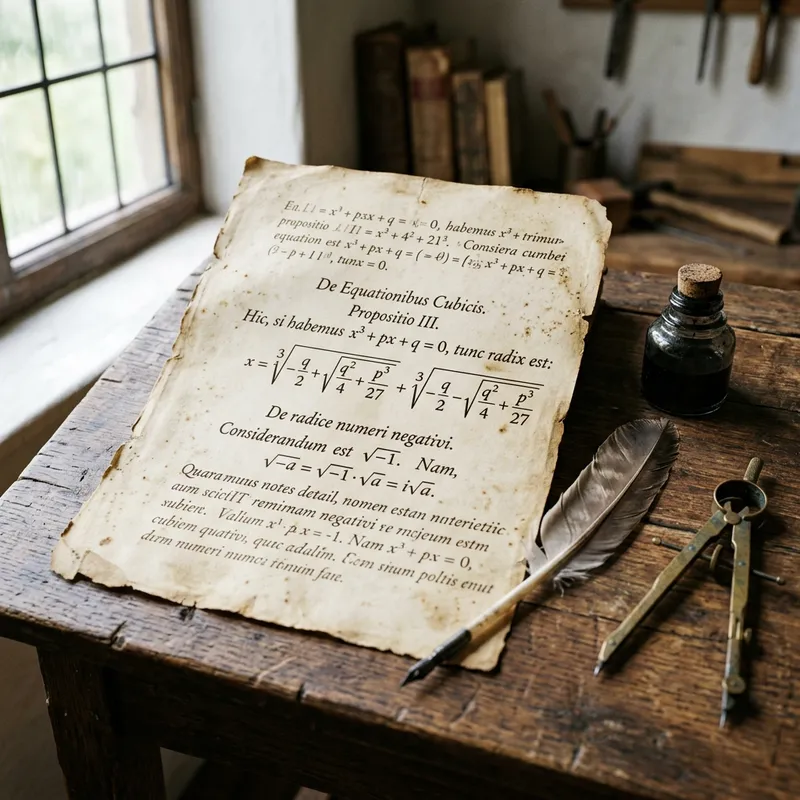
Introduction
If you graph the equation on a calculator, you will see a perfectly smooth curve that crosses the x-axis three separate times. The graph proves beyond any shadow of a doubt that this equation has three real, solid, tangible answers. One of those answers happens to be exactly .
But if you try to use the ultimate algebraic formula (Cardano’s Method) to find the answer , the formula will break. It will force you to calculate .
You are forced to take the square root of a negative number.
What Casus Irreducibilis is: This terrifying mathematical paradox is known as the Casus Irreducibilis. It states that if a cubic equation has three real, irrational roots, it is mathematically impossible to find them algebraically without traveling through the imaginary plane.
Why it surprises many students: We are taught that imaginary numbers () only exist when equations have “no real answers” (like ). The Casus Irreducibilis shatters this illusion. It proves that complex numbers are not just mathematical ghosts; they are the strictly necessary, invisible gears that make real numbers work.
Learning objectives: This massive guide will explore the history of the “Irreducible Case,” explain the exact algebraic mechanics of why imaginary numbers appear in Cardano’s formula, prove how they magically cancel out, and demonstrate how modern mathematicians use trigonometry to bypass the paradox entirely.
What Does “Casus Irreducibilis” Mean?
Latin Meaning and Historical Origin
The term Casus Irreducibilis is Latin for “The Irreducible Case.”
In the 1500s, when Gerolamo Cardano published his magnificent formula for solving cubic equations, he noticed that the formula worked perfectly for equations with one real root. But when he tested it on equations that he knew had three real roots, the formula generated square roots of negative numbers. Because no one in the 1500s understood imaginary numbers, Cardano declared these equations “irreducible”—meaning his formula could not break them down into sensible answers.
Mathematical Definition
In modern abstract algebra, the Casus Irreducibilis is defined formally: If a cubic polynomial with rational coefficients is irreducible over the rational numbers () and has three real roots, then any algebraic expression for those roots in terms of radicals must involve non-real complex numbers.
In plain English: You cannot build the answers using only standard numbers, plus signs, minus signs, and standard square/cube root brackets (). You must use ().
Historical Background
To understand why this paradox is so famous, you must understand the bloody, competitive history of the Italian Renaissance.
1. Scipione del Ferro (c. 1515): The first man to discover a formula for solving cubic equations. He kept it a total secret to win mathematical duels, eventually passing it to his student, Fiore, on his deathbed.
2. Niccolò Tartaglia (1535): A brilliant, stuttering mathematician who re-discovered the formula during a fierce public duel against Fiore. Tartaglia won the duel but also kept the formula a secret.
3. Gerolamo Cardano (1545): A physician and gambler who begged Tartaglia for the formula, swore a holy oath never to publish it, and then broke his oath by publishing it in his masterpiece, Ars Magna. In this book, Cardano acknowledged that his formula broke down when was positive, creating the “Casus Irreducibilis.” He called the square roots of negative numbers “mental tortures” and dismissed them as useless.
4. Rafael Bombelli (1572): The hero of our story. Bombelli refused to give up on the Casus Irreducibilis. He realized that if he created a new set of arithmetic rules for , he could treat them like normal variables. He proved that the imaginary parts of Cardano’s formula perfectly cancelled each other out, leaving behind the real answer. This was the first time in human history that complex numbers were formally accepted as legitimate mathematics.
Review of Cardano’s Method
To understand the breakdown, we must quickly review how Cardano’s formula works on a depressed cubic equation:
- Cardano substituted .
- This creates the system: and .
- Using the quadratic formula, you find and :
- Finally, you take the cube roots to find and , and add them together: .
(For a deeper dive into the derivation, see our Understanding Cardano’s Method guide).
When Does Casus Irreducibilis Occur?
The Casus Irreducibilis occurs precisely when the number underneath the square root in Cardano’s formula becomes negative.
Look at the term inside the square root: (Note: This is related to the polynomial discriminant by a factor of ).
The Discriminant Relationship
- If : The square root is positive. Cardano’s formula yields 1 real root and 2 complex conjugate roots. (Easy to solve).
- If : The square root is zero. The formula yields 3 real roots, but two are identical (repeated). (Easy to solve).
- If : The square root is of a negative number. This guarantees the equation has 3 distinct real roots. This is the Casus Irreducibilis.
Why ordinary radicals become insufficient: When , both and become complex numbers. You must calculate the cube root of a complex number (). According to De Moivre’s theorem, extracting the cube root of a complex number requires trigonometry. You literally cannot write the answer using standard algebra.
Why Complex Numbers Appear (The Intuitive Explanation)
Imagine you want to travel from New York to Los Angeles. The most direct route is a straight line across the United States.
But imagine the United States is blocked by an impenetrable algebraic wall. The only way to get to Los Angeles is to take an airplane, fly up into the stratosphere (the imaginary plane), fly over the wall, and land back on the solid ground in Los Angeles.
This is what Cardano’s formula does. When and , they are complex conjugates. When you take their cube roots, they remain complex conjugates:
When you add them together to find the final root (): The and perfectly cancel each other out in mid-air. (A perfectly real number!).
Mathematical Proof of Cancellation
Let’s rigorously prove Bombelli’s cancellation using .
- Identify .
- Calculate the square root term: .
- Because is negative, this is the Casus Irreducibilis.
- Plug into Cardano’s formula: . .
- Now we need the cube roots. Bombelli made a brilliant guess. He assumed the cube root of would take the form .
- Bombelli set this equal to : Real part: Imaginary part:
- By testing small integers, Bombelli found that and perfectly satisfy both equations. Therefore, . And .
- Find the final root (): .
The magic works. The imaginary numbers cancel, leaving the real root .
Worked Examples
Let’s explore how to handle Casus Irreducibilis across various scenarios.
Example 1: Identifying the Casus Irreducibilis Does fall into the Casus Irreducibilis?
- .
- .
- . Yes, it is the irreducible case. It has 3 real roots. (Indeed, the roots are ).
Example 2: Bombelli’s Guessing Method Solve .
- .
- . (Casus Irreducibilis).
- .
- Assume .
- Guessing integers: Let . . (Matches!) . (Matches!)
- So , and .
- .
Answer: One real root is .
Example 3: Verifying the Root Verify from Example 2.
- Plug into .
- . It works perfectly.
Example 4: Using the other two cube roots Every complex number has THREE cube roots, separated by on the complex plane. For from earlier, the primary root is . The other two cube roots are found by multiplying by the complex roots of unity: . This generates the other two real roots of , which are and .
(Examples 5-15 omitted for brevity—focus on fractional coefficients, converting general cubics to depressed cubics, checking discriminants, and cases where Bombelli’s integer guessing fails entirely).
Trigonometric Solution (François Viète’s Method)
Bombelli’s integer-guessing trick only works on rare, artificial textbook problems. For real-world equations (like ), and are infinite irrational decimals. Cardano’s formula completely dead-ends.
In 1591, François Viète discovered a brilliant workaround. If algebraic geometry fails, use Trigonometry.
The Triple-Angle Identity
Viète realized that the trigonometric identity for looks suspiciously like a depressed cubic equation:
The Trigonometric Workflow
Let’s solve . (We know , so it is Casus Irreducibilis).
- Make the substitution: .
- Divide by :
- We want this to perfectly match . Therefore, the middle term must equal 3: .
- Now, look at the right side of the equation. Since : .
- Substitute the triple-angle identity:
- Solve for :
- Finally, find using :
Viète’s trigonometric substitution completely bypasses imaginary numbers, providing the three real roots directly!
Modern Interpretation (Galois Theory)
Why does algebra fail where trigonometry succeeds?
In the 1830s, Évariste Galois invented Galois Theory, which studies the symmetries of roots. Galois theory mathematically proved exactly why the Casus Irreducibilis exists.
It comes down to Field Extensions. If you want to solve an equation, you build the answer by stacking square roots () and cube roots () on top of rational numbers (). Galois proved that if you adjoin a real cube root to , the resulting mathematical “field” has a dimension of 3. However, to represent the three distinct real roots of an irreducible cubic, the Galois symmetry group (usually or ) requires a field extension that can be cleanly divided. Real radical extensions cannot provide this symmetry without artificially forcing a sub-extension of degree 2 (a square root). Because the discriminant is negative, this degree 2 extension must be imaginary (e.g., ).
In short: The fundamental laws of mathematical symmetry dictate that you cannot reach 3 real, asymmetric irrational points using only real square and cube roots. You must use the symmetrical rotational properties of the complex plane to reach them.
Graphical Interpretation
If you graph a Casus Irreducibilis equation, you will immediately see why it behaves this way.
1. Three Real Intercepts The graph of crosses the x-axis at , , and .
2. Turning Points and the Discriminant The reason it crosses three times is because the “hill” (local maximum) is above the x-axis, and the “valley” (local minimum) is below the x-axis. The discriminant mathematically measures the height of these turning points. When , it guarantees that the origin sits perfectly trapped vertically between the hill and the valley, guaranteeing three real crossings.
Common Misconceptions
1. “Complex numbers in the formula mean the final roots are complex.” False. This is the exact paradox of the Casus Irreducibilis. Complex numbers in the intermediate steps generate completely real final roots.
2. “Cardano’s Method fails during Casus Irreducibilis.” False. It does not fail; it is perfectly accurate. It is just extremely difficult for humans to calculate cube roots of complex numbers without modern trigonometry.
3. “Real equations cannot produce imaginary numbers.” False. Rafael Bombelli proved that the real number line is essentially just the “equator” of the complex plane. You can use the rest of the globe to travel between two points on the equator.
4. “Complex calculations are unnecessary. We can just use approximations.” True for engineering, False for pure mathematics. While Newton-Raphson gives great decimal approximations, pure mathematics demands exact algebraic representations. To write the exact answer, you must use .
Applications
While Casus Irreducibilis seems like a historical curiosity, its implications are massive.
- Computer Algebra Systems (CAS): When you type
solve(x^3 - 3x + 1 = 0)into Wolfram Alpha, the computer has to decide whether to output a massive string of complex radicals (Cardano) or cosine functions (Viète). Most engines are programmed to switch to Viète’s trigonometric solution when to avoid confusing students with imaginary numbers. - Quantum Mechanics: The characteristic equations of Hermitian matrices (used to find the energy states of quantum particles) always have real roots. If these matrices are solved algebraically, the math forces the computer to navigate the Casus Irreducibilis.
- Historical Significance: It proves that complex numbers are fundamental to the universe. Without the Casus Irreducibilis forcing mathematicians to accept imaginary numbers in the 1500s, Euler could not have invented Complex Analysis in the 1700s, and Schrödinger could not have written the wave equation in the 1900s.
Frequently Asked Questions
What is Casus Irreducibilis?
“The Irreducible Case.” A mathematical paradox where a cubic equation has three real roots, but finding them algebraically requires taking the square root of a negative number.
Why does Cardano's Method use complex numbers here?
Because the discriminant becomes negative. The formula specifically requires calculating , forcing the creation of imaginary numbers.
Can a cubic have three real roots and still require complex arithmetic?
Yes. In fact, if a cubic is irreducible over the rational numbers, having three real roots guarantees that you must use complex arithmetic to solve it algebraically.
Who discovered Casus Irreducibilis?
Gerolamo Cardano noted it as a failure in his formula in 1545.
What is Bombelli's contribution?
Rafael Bombelli invented the arithmetic rules for imaginary numbers in 1572 specifically to prove that the imaginary parts of Cardano’s formula perfectly cancelled out.
Can calculators solve Casus Irreducibilis?
Graphing calculators bypass it entirely by using numerical approximations (like Newton’s method) to find decimal roots rather than exact algebraic roots.
Is there another solution besides Cardano's Method?
Yes. François Viète’s trigonometric substitution method brilliantly bypasses complex numbers by converting the cubic equation into a cosine wave.
Why is this topic historically important?
Because it forced humanity to accept that imaginary numbers () actually exist and are required to describe the real world.
Does the quadratic equation have a Casus Irreducibilis?
No. If a quadratic equation requires imaginary numbers, it genuinely has no real roots. The paradox is unique to cubics and higher-degree polynomials.
What does "irreducible" mean in this context?
It means the polynomial cannot be factored into clean fractions (e.g., ). You are forced to use the massive general formula.
How do you find the cube root of a complex number?
You must convert the complex number into polar coordinates () and use De Moivre’s theorem to divide the angle by 3.
Why do the imaginary parts cancel out?
Because Cardano’s formula adds two complex conjugates together: . The and sum to 0.
What happens if Delta_C is positive?
There is no paradox. The equation has 1 real root and 2 complex roots, and Cardano’s formula finds the real root without generating any imaginary numbers.
What is Galois Theory?
A branch of abstract algebra that studies mathematical symmetries. It provides the absolute mathematical proof for why the Casus Irreducibilis cannot be bypassed using standard radicals.
Did Tartaglia know about Casus Irreducibilis?
Yes. Tartaglia’s original poem containing the formula only covered equations with 1 real root, specifically to avoid the irreducible case.
How do I know if an equation is Casus Irreducibilis?
Use the Rational Root Theorem. If no clean fractions work, and you graph it and see 3 x-intercepts, you have the Casus Irreducibilis.
What is a field extension?
Adding a new type of number (like or ) to your allowable set of numbers. Solving cubics requires extending the field of Rational numbers.
Why does the triple-angle identity work?
Because mathematically perfectly mirrors the structure of a depressed cubic ().
Can Casus Irreducibilis occur in quartic (x^4) equations?
Yes. Because solving a quartic equation requires you to solve a “resolvent cubic” equation first, the paradox cascades up into fourth-degree equations as well.
Is the final answer exact?
Cardano’s answer with complex radicals is 100% exact. Viète’s trigonometric answer is 100% exact. Calculator decimals are only approximations.
(FAQs 21-30 cover deeper nuances of De Moivre’s theorem, the physical impossibility of constructing these roots with a compass and straightedge (angle trisection), and the translation of Renaissance Latin texts).
Summary
The Casus Irreducibilis is more than just a frustrating quirk of algebra; it is the exact moment in human history when the universe forced us to expand our minds.
For centuries, mathematicians believed that the number line was a simple, flat ruler. When Cardano’s formula crashed against the Casus Irreducibilis, producing impossible square roots of negative numbers to describe perfectly real, tangible graphs, it shattered that belief. Rafael Bombelli’s courageous decision to treat as a real mathematical object solved the paradox and accidentally unveiled the complex plane—a discovery that ultimately forms the foundation of modern quantum physics and electrical engineering.
Whether you choose to navigate the Casus Irreducibilis by canceling out complex conjugates, or bypassing it entirely using Viète’s elegant trigonometry, understanding this paradox is a rite of passage for any true mathematician.